From a Study of an Old Man at Twenty-Five to The Jewish Bride: Eight Rembrandt Paintings in the Order He Painted Them
Published
Rembrandt was born in Leiden in 1606 and died in Amsterdam in 1669. As a young man he was the most sought-after portrait painter in Amsterdam. Around fifty he went bankrupt and had to give up his house and his collection. Eight paintings from the years in between are on this site: four at the Rijksmuseum in Amsterdam, two at The Metropolitan Museum of Art in New York, and one each at the National Gallery of Art in Washington and the Art Institute of Chicago. All four museums have released public domain images, which made it possible to bring them together in one place.
| Order | Work | Date | Collection | Size (cm) |
|---|---|---|---|---|
| 1 | Old Man with a Gold Chain | 1631 | Art Institute of Chicago | 83.1 × 75.7 |
| 2 | The Night Watch | 1642 | Rijksmuseum | 363 × 437 |
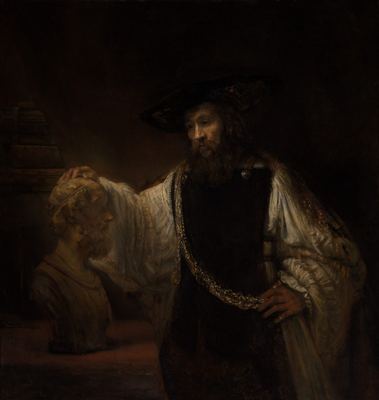
| 3 | Aristotle with a Bust of Homer | 1653 | The Met | 143.5 × 136.5 |
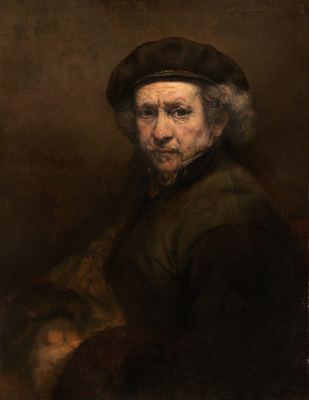
| 4 | Self-Portrait | 1659 | National Gallery of Art | 84.5 × 66 |
| 5 | Self-Portrait | 1660 | The Met | 80.3 × 67.3 |
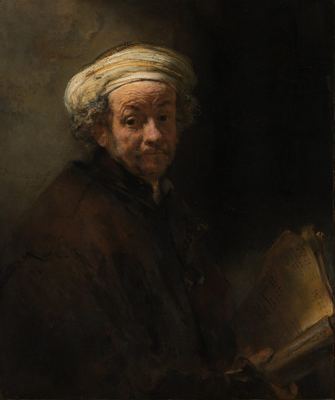
| 6 | Self-portrait as the Apostle Paul | 1661 | Rijksmuseum | 91 × 77 |
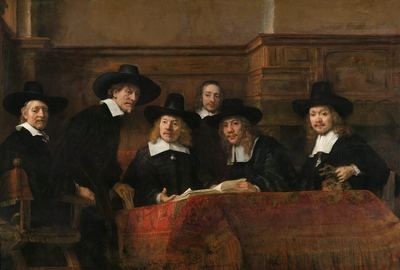
| 7 | Syndics of the Drapers’ Guild | 1662 | Rijksmuseum | 191.5 × 279 |
| 8 | The Jewish Bride | ca. 1665–69 | Rijksmuseum | 121.5 × 166.5 |
Seen in order, the eight cover thirty years at a glance. Most of them date from the late 1650s on, which tells you he kept painting after the bankruptcy.
Twenty-five, testing light on metal
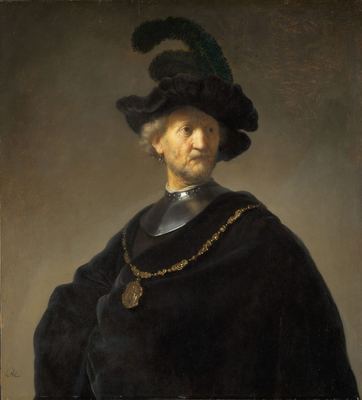 Solve this painting as a puzzle → about 5 minutes on Easy
Rembrandt painted Old Man with a Gold Chain in 1631, around the time he was moving from his hometown of Leiden to Amsterdam. It isn’t a commissioned portrait. He dressed an elderly model in a plumed hat, pieces of armor and a gold chain, and studied how light falls differently on each material. In the Netherlands this kind of picture was called a tronie. Some say the model was the painter’s father, but that has never been confirmed. For a twenty-five-year-old, the glint of the metal is already the work of an old hand.
The biggest painting: The Night Watch
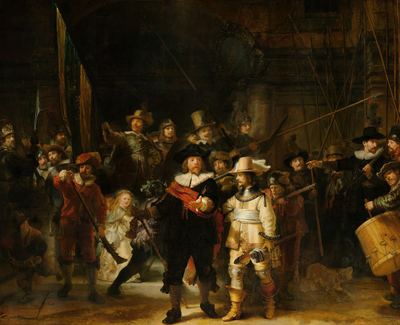
Eleven years later came The Night Watch, more than four meters wide. It is a group portrait commissioned by Amsterdam’s arquebusiers’ militia company to hang in their hall. Rembrandt threw out the convention of lining everyone up in a row and painted them instead in motion, just about to march out. The captain in his red sash strides forward with his hand outstretched, and a drummer, a dog and a small girl caught in the light are mixed in among the men. Despite the title, it is a daytime scene. The name was given after the varnish darkened and made it look like a night picture. In 1715, when it was moved to the town hall, its left edge was cut off so it would fit the wall.
As a puzzle it is surprisingly easy to keep your bearings, because there are so many figures. The captain’s red sash, his lieutenant’s yellow outfit and the girl’s golden dress form a bright band across the middle, and the darkness is what’s left around it.
The philosopher and the poet
Aristotle with a Bust of Homer was commissioned in 1653 by a Sicilian nobleman. The philosopher, wearing a gold chain, rests his hand on a bust of the blind poet. The chain and medal are usually read as a gift from Alexander the Great, his former pupil. One reading has the philosopher weighing worldly honor against lasting poetry; another sees the painter himself, hard pressed by commissions. In 1961 The Metropolitan Museum of Art made the news by buying it for what was then the highest price ever paid for a work of art at auction. In the puzzle, the gold links of the chain run in a line across the darkness, and if you follow them, the philosopher’s body appears.
Three faces after the bankruptcy
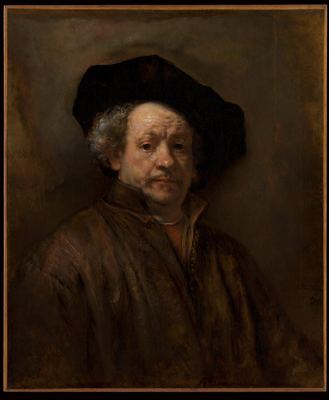
Rembrandt painted close to eighty self-portraits over his life. When he was young he staged himself in fine clothes and theatrical expressions. After his bankruptcy in 1656 he painted his aging face just as it was. This site has three, painted over three years starting in 1659.
The Self-Portrait in Washington shows him at fifty-three. Under the beret, his eyes look straight out at you. A year later comes the Met’s Self-Portrait, the face of a man who had already outlived his wife and several of his children. A year after that, in the Rijksmuseum’s Self-portrait as the Apostle Paul, he has wrapped a white cloth around his head and holds a manuscript as Saint Paul. The sword hilt inside his cloak is Paul’s attribute. Put the three side by side and you can watch the same man’s wrinkles deepen year by year.
As puzzles, the three self-portraits are about equally hard. Only the face is light; everything else is brown and black. Join the face and the brim of the hat first, line up the remaining pieces from lightest to darkest, and work down from the background at the top. In the Washington painting the upper left of the background is a slightly lighter tawny brown, which makes it easier to find a place to start. If you’re new to them, open with 48 pieces.
The last group portrait and the last couple
Syndics of the Drapers’ Guild was commissioned in 1662 by Amsterdam’s guild of cloth makers. The syndics, whose job was to inspect the quality of dyed cloth, sit at a table covered with a red rug and all look up at us at once. It feels as if you have just walked into the room in the middle of their meeting. It is known as the last group portrait Rembrandt painted. Black coats and white collars line up behind the table, so in the puzzle you place the men one at a time by where their white collars fall.
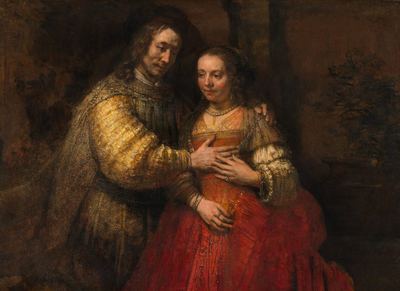
The Jewish Bride comes from the last few years of his life. A man in a golden sleeve wraps his arm around a woman in a red dress. It is read as a portrait of a real couple dressed as Isaac and Rebecca from the Old Testament, and the current title was given by a collector in the nineteenth century. On the man’s sleeve, the paint was built up with a palette knife as well as a brush. There’s a story that Van Gogh could hardly tear himself away from this painting.
Leave the brown darkness for last
In all eight paintings, more than half the picture is brown and black. Working on a Rembrandt puzzle, you learn that darkness isn’t a single color. There are reddish browns, greenish blacks and ocher near the light, each piece slightly different from the next. Tips for getting through the dark stretches are in how to solve puzzles with large plain areas, and the order for starting from the face is in the portrait puzzle guide. Where Vermeer, his contemporary in Delft, painted morning sunlight on white walls, Rembrandt left a single face in the dark. To compare the two painters, set this post next to eight Vermeer paintings. If you’re planning a trip to Amsterdam, where four of these hang, there’s also the Rijksmuseum guide.
The two hands in The Jewish Bride sit in the very middle of the picture, in its brightest spot. When you fit the last piece over those hands, you feel you understand what a painter who spent thirty years building up darkness wanted, in the end, to light.
Frequently asked questions
What are Rembrandt's most famous paintings?
The best known is The Night Watch from 1642. The Jewish Bride and the Syndics of the Drapers' Guild from his last years, Aristotle with a Bust of Homer, and the self-portraits he painted throughout his life are usually named alongside it. Eight of these are available as puzzles on this site.
Which museums have Rembrandt's paintings?
Of the eight on this site, four are at the Rijksmuseum in Amsterdam, two at The Metropolitan Museum of Art in New York, and one each at the National Gallery of Art in Washington and the Art Institute of Chicago.
Why are Rembrandt puzzles so hard?
More than half of each picture is brown and black, so you can't sort the pieces by color. Join the parts that catch the light first, such as faces, white collars and gold jewelry, then line up the dark pieces from lightest to darkest and fill them in last.