What Is Chiaroscuro? Chiaroscuro, Sfumato and Tenebrism Explained with Famous Paintings
Published
Chiaroscuro is a painting technique that separates the bright parts that catch the light from the dark parts in shade, giving things on a flat surface volume and mood. The word is Italian, joining chiaro, meaning “light,” and scuro, meaning “dark.” Shade one side of a plain circle light and the other side dark, and it becomes a ball. Chiaroscuro takes that principle and extends it to the whole picture.
Three names for light and dark
Three words that come up often in art class all deal with light and dark, but each uses them differently.
- Chiaroscuro: The broad term for light-dark contrast as a whole. You decide which side the light comes from, then divide an object into a lit side, a middle tone and shadow to build volume.
- Sfumato: Italian for “like smoke.” Without drawing outlines, the painter moves from light to dark very gradually. Leonardo da Vinci is its best-known master.
- Tenebrism: From the Italian tenebroso, meaning “dark.” The background is left almost black and a strong light from one side makes only the figures stand out. Caravaggio is its best-known master.
Leonardo: soft, without lines
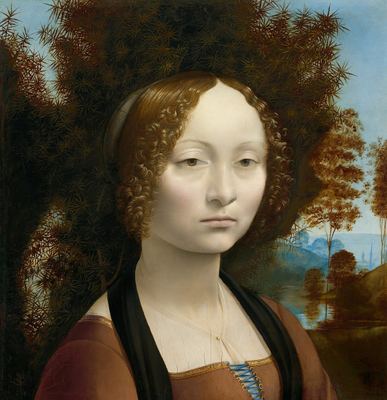
Renaissance painters moved away from filling outlines with color and built form out of light and shadow instead. Leonardo is famous for later perfecting sfumato in the Mona Lisa. Even in Ginevra de’ Benci, painted in his twenties, the pale face floats in front of a dark juniper, and the shadows within the face pass from one tone to the next without lines. Other features of Renaissance painting are covered in what is Renaissance art.
Caravaggio: light like a spotlight
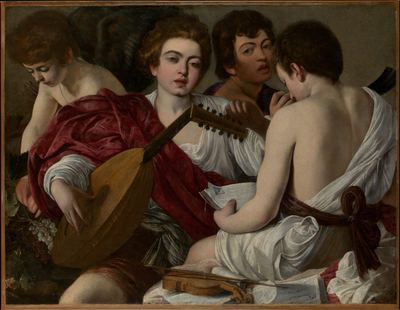
In the early 17th century, Caravaggio pushed light-dark contrast to the extreme. In The Musicians (about 1597) the background is dark and only the boys’ skin and white clothing are bright. This effect, in which figures seem to leap forward out of the darkness, spread to painters all over Europe and became a defining feature of Baroque art.
Rembrandt: faces in the dark
Rembrandt gathered light in one place, in pictures that seem to shine into the sitter’s very mind.
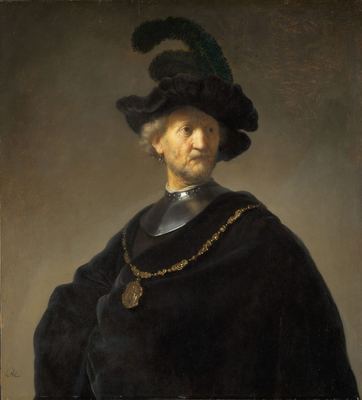
- Old Man with a Gold Chain (1631): A painting in which the 25-year-old Rembrandt studied light and texture. Light comes in from the left onto the wrinkled forehead and the white-bearded chin, and the gold chain gleams at a slant across the black cloak.
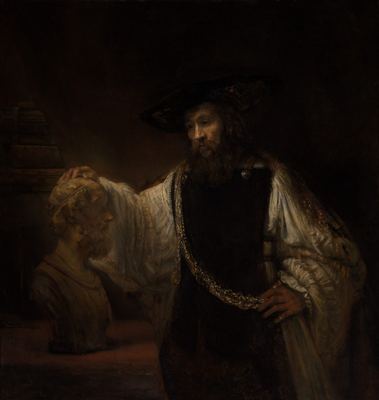
- Aristotle with a Bust of Homer (1653): The light touches only the philosopher’s face, his white sleeves and the marble bust. More than half the picture is darkness.
To see Rembrandt’s paintings in the order he painted them, see eight paintings by Rembrandt.
Candlelight and window light
Where the light comes from also changes a picture’s mood.
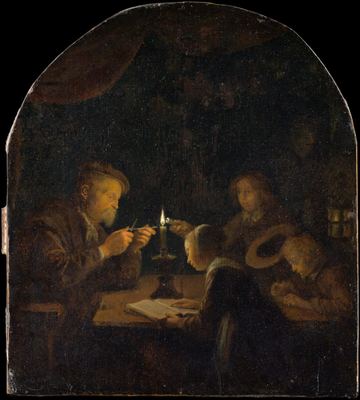
- Candlelight: Rembrandt’s first pupil, Gerrit Dou, loved to paint night scenes in which a single candle sets the light and dark of a whole room. In An Evening School, 25 cm tall, the candle lights only the books on the table and the children’s faces, and the rest is pitch dark.
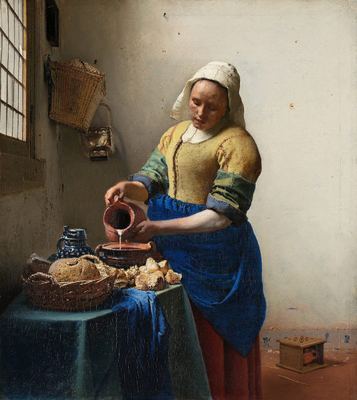
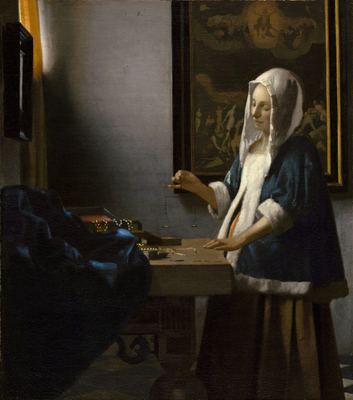
- Window light: Instead of dramatic contrast, Vermeer painted the soft light that comes through a window on the left. In The Milkmaid the light falls on the white wall and the woman, and in Woman Holding a Balance it enters through a window hung with an orange curtain and lights the gray wall at a slant.
Trying light and dark at home or in class
You can try chiaroscuro yourself with a single pencil.
- Draw five squares on paper and shade them darker and darker from left to right to make a value scale.
- In a dark room, set down an apple or a ball and shine a flashlight on it from one side. Find the brightest spot, the middle tone, the shadow on the object and the shadow cast on the table.
- Draw the apple using the five steps of your scale. The trick is not to press a dark outline.
Move the flashlight and the same apple becomes a completely different picture. You will feel right away why Rembrandt and Caravaggio cared so much about the direction of light. If you are writing a response to a painting, where the light comes from is good material for the analysis step. How to write an art appreciation essay
Seeing light and dark through puzzles
Paintings with strong contrast have many dark pieces, so they tend to be hard as puzzles. But once you know the rules of light, the order becomes clear.
- Where the light falls first. Join the bright pieces, such as faces, hands, white clothing and the area around a candle, first to set up the skeleton of the forms.
- Split left from right by the light’s direction. Because the light comes from one side, even the same darkness is a little brighter on the light side. Use that difference to sort pieces left and right.
- Look for color within the black. Dark pieces too differ slightly, with hints of brown, olive or red. Turn on the preview and compare. Tips for fitting wide single-color areas are in how to solve puzzles with large solid backgrounds.
- Start with window-light paintings. Begin with bright pictures like Vermeer’s, and take on paintings with wide darkness, such as An Evening School or Aristotle, at a lower piece count.
Frequently asked questions
What does chiaroscuro mean?
It is a painting technique that separates the bright parts that catch the light from the dark parts in shade, giving things on a flat surface volume and mood. The word is Italian, from chiaro (light) and scuro (dark).
How are chiaroscuro, sfumato and tenebrism different?
Chiaroscuro refers to light-dark contrast as a whole. Sfumato joins light and dark softly, like smoke, without outlines, and Leonardo da Vinci is its best-known master. Tenebrism shines a strong light from one side onto a dark background, and Caravaggio is its best-known master.
Which painters used chiaroscuro well?
Leonardo da Vinci, Caravaggio and Rembrandt are the classic examples. Rembrandt's first pupil, Gerrit Dou, was known for night scenes lit entirely by a single candle, and Vermeer for the soft light coming through a window.