A Close Look at Four Byzantine Gold Coins, 2cm Across, as Puzzles
Published
A single gold coin the size of a fingernail holds an emperor’s face, a crown and lettering running around the edge. This is the story of four gold coins of the Byzantine Empire in the Medieval Art department. The Metropolitan Museum of Art received them as a bequest in 2020, and their actual diameters are only 1.4 to 2 centimeters. On the puzzle screen they grow large enough to fill your palm.
| Work | Date | Size |
|---|---|---|
| Semissis of Aelia Pulcheria | 415–453 | about 14mm |
| Semissis of Anastasius I | 491–518 | about 14mm |
| Solidus of Theophilos | 829–843 | about 19mm |
| Tremissis of Theophilos - 7 | 829–843 | no size given |
The dates are the ones recorded by the museum. They broadly coincide with the reign of the emperor or empress in question.
Solidus, semissis, tremissis
The names are unfamiliar, but the system is simple. The solidus was the standard Byzantine gold coin. After Constantine the Great first issued it, it kept its weight and purity for more than 700 years, and thanks to that it served almost as a reserve currency in the medieval Mediterranean world. The semissis weighed half as much, and the tremissis a third. They were smaller units for everyday transactions.
The solidus for large transactions, the semissis or tremissis for small ones. Think of the relationship between large bills and small change today.
From profile to frontal face
Put the four coins in chronological order and the emperor turns his head.
 Solve this painting as a puzzle → about 5 minutes on Easy
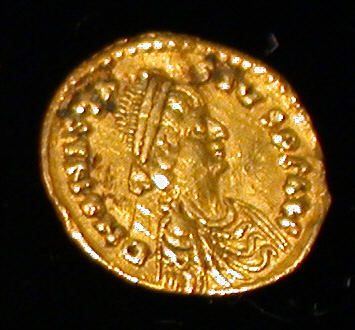
The earliest is the coin of Anastasius I from the late 5th century. The emperor, wearing a pearl diadem, is shown in profile facing right, with armor and a cloak over his shoulders. It carries on the profile portrait that Roman coins had long used.
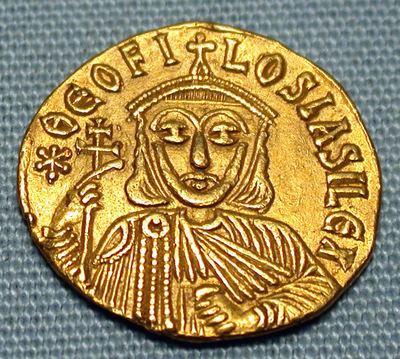
Nearly 400 years later, in the 9th century, the emperor on the coin of Theophilos faces forward. He wears a crown and holds a cross-scepter, and around the edge runs the Greek inscription “Theophilos basileus (emperor).” After Anastasius, Byzantine coins gradually shifted to frontal portraits like this. The change of lettering from Latin to Greek is part of the same trend. Set the two coins side by side, and the 400 years in which the Roman coin became the Byzantine coin come into view at a glance.
CONOB on the reverse of the Pulcheria coin
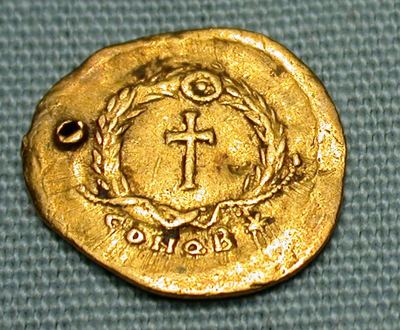
For Pulcheria’s semissis, the puzzle uses the reverse rather than the obverse. A cross sits inside a laurel wreath, and below it the letters “CONOB” are struck.
CONOB is a mark meaning pure gold made at the Constantinople mint. In today’s terms it was something like a quality guarantee. Every coin, in effect, went around announcing “this gold is pure.” The cross stands for the Christian empire, and the laurel wreath for victory.
Pulcheria was the sister of the Eastern Roman emperor Theodosius II. She led the government on behalf of the young emperor and later became empress herself. The reverse of this coin, however, carries only her name without her portrait, so it is hard, with the material available now, to dig further into exactly whom the coin was made to honor.
Theophilos, emperor of the Iconoclast era
Theophilos (reigned 829–843) was the last emperor to ban the veneration of icons, and he was also a patron of learning and architecture. During the Iconoclast period, religious paintings and sculpture were forbidden. At such a time, coins were one of the few images the empire could display before its people. Gold coins bearing the emperor’s face and a cross circulated to every corner of the empire, so in a sense you could call them the public art of their time.
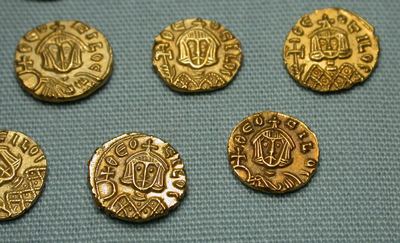
The tremissis image shows six gold coins together in one photograph. Their sizes and degrees of wear differ slightly. Even coins struck for the same emperor in the same years each have their own expression.
One gold circle and a plain background
Coin puzzles always have a plain background. A gold coin on blue cloth, a gold coin on black. There is one gold circle in the middle, and the rest is flat. The strategy for pictures with large areas of a single color applies almost exactly.
Your reference points are the face and the lettering. Start with pieces of clear shape, like the emperor’s face, the crown and the cross. The “face first” rule from the portrait puzzle guide works on coins too. The lettering around the edge curves along the rim, so the angle at which the letters in a piece tilt tells you which part of the edge it belongs to. Fill in plain areas like the blue cloth or the black background last, after the outline of the coin is complete.
Keep the piece count low. About 48 pieces for the solidus and the tremissis, and 24 for the two semisses. In the tremissis, the round outlines of the six coins each serve as a reference point, so it is plenty of fun even at 48 pieces.
A world struck on a fingernail-sized surface
The real coins are only a little larger than a fingernail, so with the naked eye it is hard even to tell where the face is. The puzzle screen enlarges these small objects to the size of your palm, showing even the traces of the hammered surface and the worn edges. More small objects from the same department are gathered in small treasures of the Middle Ages.
A gold coin that passed from one hand to another 1,500 years ago. As you fit it back together piece by piece, you end up reading, very slowly, the world struck on that small surface.