Courtiers in a Rose Garden: Three 15th-Century Tapestries
Published
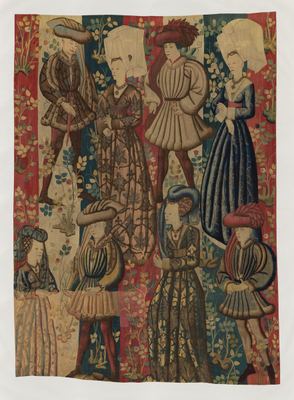
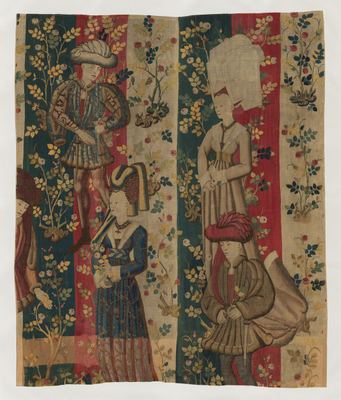
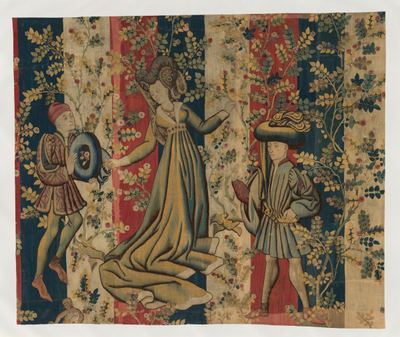
Rose vines climb over vertical stripes of red, white, and blue, and among them stand ladies in pointed headdresses and gentlemen in short coats. These are the three tapestries in the Medieval Art section, Courtiers in a Rose Garden. According to the museum’s records, they were made in the South Netherlands in the mid-15th century (around 1440–50), and the medium is “wool warp; wool, silk, metallic weft yarns.” They entered the collection in 1909 through the Rogers Fund.
A picture made on a loom
A tapestry is a picture woven from colored thread instead of paint. Threads are strung vertically, and the pattern is built up by passing horizontal threads of many colors between them. Just thinking about the handwork that must have gone into a picture this size is dizzying.
On top of that, all three are large.
 Solve this painting as a puzzle → about 5 minutes on Easy
| Work | Size (height × width) |
|---|---|
| Four Gentlemen and Four Ladies | 378.5 × 264.2 cm |
| Two Ladies and Two Gentlemen | 314.3 × 247.7 cm |
| A Lady and Two Gentlemen | A little over 3.2 m wide (per the commentary) |
The largest is nearly 3.8 meters tall. It would cover an entire wall of an ordinary room. The three are thought to have come from a series that once surrounded a single room, but I could not confirm how many pieces there were originally or how they were hung.
Rose vines over stripes
All three have rose vines twined over a ground of red, white, and blue vertical stripes. They do look like the heraldic colors of a particular family. This site’s sources give no basis for saying which family.
What catches the eye more is the rhythm the ground creates. The stripes stand straight and vertical, and the rose vines wind across them. Where the straight lines and the curving lines overlap, the people seem to float above the garden.
Pointed hats and metal thread
The figures’ clothes appear to follow the fashions of the Burgundian court in the mid-15th century. The men wear short coats over long, tight-fitting hose. The women wear tall, pointed headdresses and gowns that trail on the floor. Metal thread is mixed into the clothes here and there, so they still shimmer softly after all these years.
Records that preserve the fashions of a time before photography in this much detail are rare, so these tapestries are also used as sources for the history of dress. To compare them with clothing patterns from another culture, it helps to open Dress and patterns in Islamic art alongside.
Judging left and right from the stripe order
Because the striped ground covers the whole picture, there is a method that works only for these pieces. Red, white, and blue repeat in a fixed order, so reading the color order on a background piece gives you a rough idea of whether it belongs on the left or the right side of the picture. It cannot tell you top from bottom, because the stripes look the same all the way up and down. Find the height using the colors of the figures’ clothes and their faces. It is easiest to complete the figures first and then fill the spaces between them with stripe pieces.
The green vine and rose pieces all look alike, so put them off until the very end. Once you have built the skeleton from the figures and stripes, fill the gaps by following the direction the vines grow. It is a way of carrying the strategy for single-color areas over to a patterned ground.
Four Gentlemen and Four Ladies has eight figures, which gives you plenty to hold on to, so even Hard (about 100 pieces) is worth trying. A Lady and Two Gentlemen has only three figures and a lot of background, so it is better to start at Normal (about 48).
Embroidered pictures and woven pictures
A picture made stitch by stitch with a needle appears in The story of an embroidered sampler. The difference between needle and loom shows directly in the texture of the surface, so reading the two posts together reveals another side of textile pictures. Unlike wall-covering tapestries, the medieval objects people held in their hands are gathered in Small treasures of the Middle Ages.
Medieval courtiers covered their walls with tapestries like these to warm their rooms and to show off their household’s standing at the same time. As you stand up, piece by piece on the screen, people who have stood on walls for more than five hundred years, it feels like returning them to their original places among the stripes and roses.