Reading the Symbols in Florentine Madonna and Child Paintings Through a Pomegranate and a Ruined Wall
Published
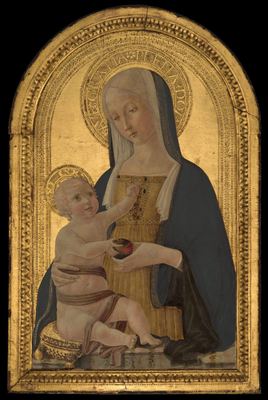
The Christ Child holds a red fruit. In another painting, the child lies on the grass, and behind him a crumbling wall can be seen. At a glance, Madonna and Child paintings may all seem much the same, but meaning is loaded into each of these small details. The four works from the Robert Lehman Collection are paintings of the Madonna and Child and the Annunciation made in Florence (and Siena) between 1475 and 1510. Their faces may look alike, but the symbols they carry differ from one to the next.
| Work | Artist | Date |
|---|---|---|
| Madonna and Child (pomegranate) | Benvenuto di Giovanni | ca. 1475–85 |
| Madonna Adoring the Child | Botticelli (workshop) | ca. 1490–95 |
| Madonna and Child with the Young Saint John the Baptist | Cosimo Rosselli | ca. 1490 |
| The Annunciation | Maestro Esiguo | ca. 1500–10 |
A pomegranate in the child’s hand
 Solve this painting as a puzzle → about 5 minutes on Easy
The child in Madonna and Child holds a red fruit in his hand. It appears to be a pomegranate, an old symbol of Christ’s Passion and Resurrection. Because the fruit holds its seeds tightly packed inside the rind, it was widely used to represent resurrection and fertility.
Benvenuto di Giovanni worked in Siena in the late 15th century. He kept the tradition of the gold-leaf ground while painting the figures’ faces much more softly. The Latin letters inscribed in the halos are phrases honoring the Virgin.
A child lying on the grass before ruins
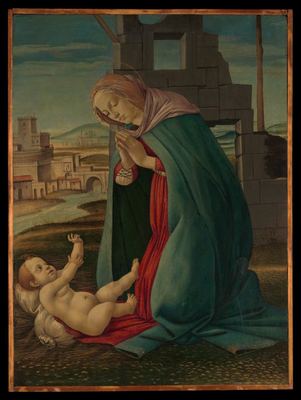
In Madonna Adoring the Child, the child lies on the grass instead of in a manger, and Mary kneels before him. This format, in which the child is laid on the ground and Mary adores him, was hugely popular in late 15th-century Florence.
The crumbled wall and city gate behind them are not just background. They carry the meaning that with the birth of Christ the old pagan world collapses and a new age begins. The painting is thought to be by Botticelli and his workshop, and Mary’s elongated fingers and soft profile are counted among Botticelli’s habits of hand. Seen next to Botticelli’s Annunciation in Robert Lehman’s great masters, it shows another face of the same painter.
A nursing mother and a young cousin
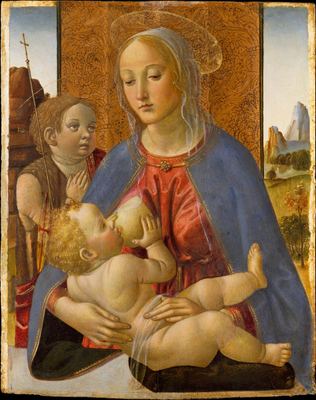
In Madonna and Child with the Young Saint John the Baptist, Mary is nursing the child. The nursing Madonna is an old iconography that emphasizes that the Son of God took on a human body. The duality of a divine being born as a human who had to be nursed sits at the center of the picture. The practice of painting the young John alongside was especially popular in late 15th-century Florence.
Cosimo Rosselli was a Florentine painter who also took part in painting the murals of the Sistine Chapel in the Vatican. He mixed oil into tempera to render the skin softly.
The nickname “the slender painter”
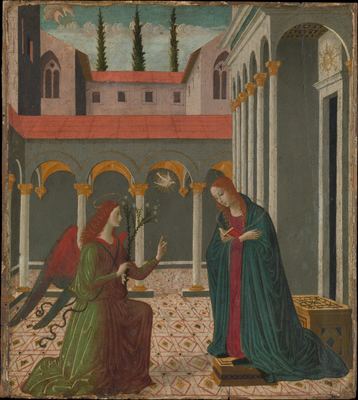
The latest of the four, The Annunciation, catches the eye with its painter’s name alone. “Maestro Esiguo” is an alias meaning “the slender painter,” given to an unknown artist who painted thin, elongated figures. These days he is sometimes identified as Alesso, the son of Benozzo Gozzoli. The practice of naming a painter after the traits of his style resembles what we saw in Orcagna’s shadow.
The loggia and cypress garden in the background were the stage that customarily appeared in 15th-century Florentine Annunciations. The precise perspective, in which the arches of the loggia and the floor tiles converge on a single point, is likewise characteristic of Florentine painting of this period.
Faces, fruit, then tiles
All four have distinct color zones, so they are not hard to tackle. For all of them, 100 pieces is about right.
The pomegranate Madonna and Child divides into the blue mantle, flesh tones, gold leaf, and the gray parapet at the bottom. Assemble the two faces and the red fruit first, then put the arch curve around the top. For the gold-leaf pieces, start with the ones that have halo lettering, and the remaining spots will narrow down on their own.
The adoration scene is layered with a blue mantle, a red garment, the child’s flesh tones, the gray ruins, and the green grass. Get Mary’s face and hands and the child first, then continue the mantle by following the bright lines in its folds. For the nursing Madonna, the three faces are the starting point. It divides into the red garment and blue mantle, flesh tones, a gold wall, and a green landscape, so after assembling the faces and the child’s body, set up the gold wall pattern behind them and fill in the landscape on either side.
In the Annunciation, the perspective lines are the key. It divides into a green garment, a blue mantle, red roofs, and a tiled floor. Assemble the two figures’ faces and the lily first, build the framework with the straight lines of the loggia arches and floor tiles, then fill in the cypresses and sky at the top.
The child’s hand, seen anew
A single pomegranate speaks of resurrection, a crumbled wall of a changing age, a nursing breast of God and man in one body, and a cypress garden of an established stage. A Madonna and Child painting is a portrait of mother and child, and also a box in which symbols have been carefully stored. After assembling these four, even in front of other Madonna and Child paintings you will find yourself looking first at what the child is holding and what stands behind. Paintings that put the same subject into a different frame can be found in Madonna and Child puzzles and the Madonna and Child Enthroned.