The Procuress and the Young Woman Who Keep Returning in Goya's Los Caprichos
Published · updated
On a pitch-dark night, before a corpse hanging from a gallows, a woman covers her face and reaches out her hand. It is one scene among the 80 plates of Goya’s Los Caprichos. I have already covered this series several times, in the bullfight prints, an overview of all of Los Caprichos, and the unpublished prison prints, but within it there is one more thread worth pulling out on its own. People clinging to superstition, and an old woman and the young woman she eggs on, appear again and again across several plates. It is a small series within the series, beginning as social satire and ending in a fantasy of goblins.
| Work | Plate | Size |
|---|---|---|
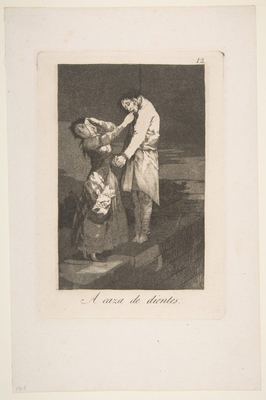
| Out hunting for teeth (A caza des dientes) | No. 12 | 21.8 × 14.9cm |
| A pretty piece of advice (Bellos consejos) | No. 15 | 21.6 × 15.1cm |
| It is nicely stretched (Bien tirada está) | No. 17 | 24.99 × 15.01cm |
| Be quick, they are waking up (Despacha, que dispiertan.) | No. 78 | 21.4 × 15cm |
A hand covering the face before the gallows
 Solve this painting as a puzzle → about 5 minutes on Easy
The woman in Out hunting for teeth covers her face with one hand and reaches the other toward the mouth of a hanged man. The corpse wears a white shirt, and the only thing shining bright in the darkness is the woman’s lace apron.
The print mocks the superstition that the teeth of a hanged man work in magic spells. Only the number and title are engraved on the plate, but a contemporary commentary handed down with the series is said to contain words pitying people who believe in such superstitions. A gesture of covering one’s eyes in fear while the hand still reaches out in the end. The whole satire lies in that single mismatch.
A whisper in the ear and a stocking
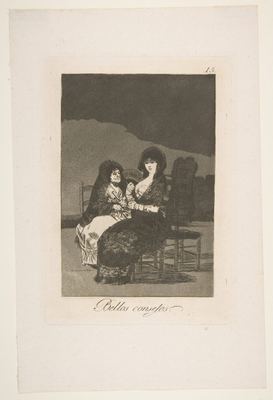
In A pretty piece of advice, a young woman wearing a black lace mantilla sits on a chair looking ahead. The old woman beside her leans over and whispers something in her ear. The mantilla is a black head scarf worn by Spanish women and a prop that appears often in Goya’s prints.
The “pretty piece of advice” of the title is a procuress’s counsel to lure a wealthy man. This old woman shows her face again here and there throughout Los Caprichos, and the two are together in the next scene as well.
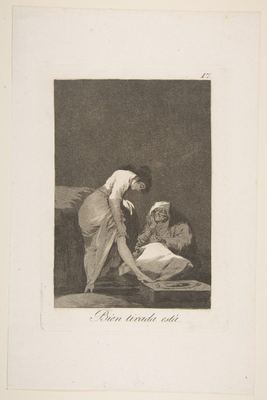
The young woman in It is nicely stretched bends at the waist to pull up her stocking, and the old woman seated beside her watches. It is a scene of checking her appearance before sending her out to a client, and the title itself is a joke with a double meaning. Place the two plates side by side and they form a short story. The old woman gives her a tip, and the young woman finishes getting ready just as told. What Goya was aiming at with such scenes was prostitution in Madrid at the time and the society that encouraged it.
Things that hurry before daybreak
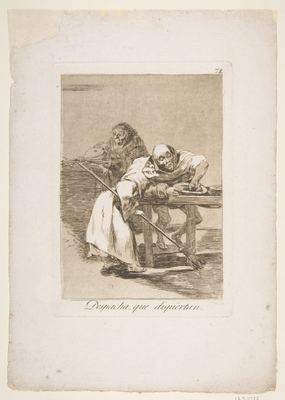
In Be quick, they are waking up, the atmosphere changes abruptly. In a room laid in gray aquatint, three hooded figures gather around a long table. The figure in front wears something like a white monk’s habit, leans on the table, and holds a long broom at a slant. The figure behind leans over the table and reaches for a stack of plates. The faces look like those of old people, or perhaps of goblins.
Los Caprichos moves toward fantasies featuring witches and goblins in its latter part, and the social satire of the earlier plates continues in the form of nightmares. This plate is commonly read as little goblins (duendes) who rush through the housework at night while people sleep and hurry off before daybreak. Some see it, on the basis of the habits and hoods, as satire aimed at monks.
On a black background, start with the white clothing
All four plates are compositions in which white clothing or pale skin floats up from a dark aquatint ground. So the strategy for paintings with large single-colored areas and the density-sorting method used in the Degas and Lautrec drawings both work here. Find the white shirt or light skirt pieces in the darkness first to establish the figures’ poses. The pieces at the bottom of the plate with the Spanish title and number engraved on them are a sure sign of the bottom of the picture. Dark background pieces are hard to tell apart, so after assembling all the figures, fill in from the edges inward. For all four plates, 24 or 48 pieces is good, and the larger the black areas, the easier it is to set the count low.
Where the old woman led
Lay them out in order and you can see the path Goya took in this series. Starting from a superstition that preys on the teeth of the dead, it passes through the dealings of a procuress and a young woman and arrives at a night of goblins. If the earlier scenes are the foolishness of the human world, the last plate looks like that foolishness pushed to its very end. The eye that glared at society’s hypocrisy at some point began to draw things that were not human.
These prints are powerful enough on their own as single sheets. Still, once you know that the same old woman appears again across several plates, the 80-plate series begins to read like a story told in one continuous line.