Los Caprichos: Goya's Satire in 80 Prints
Published · updated
On a pitch-dark night, two women whose skirts and headscarves have been blown inside out by the wind huddle together. The background is almost black, and only the women’s white clothes float in it. This is one sheet from Los Caprichos, the set of prints Goya brought out in 1799. If Goya’s bullfight prints followed the movement in the arena, this set looks into superstition and hypocrisy in the dark.
You can assemble several individual prints as puzzles, along with the album entry that gathers all 80. Most came in through Walter Sachs’s gift in 1916, and a few came by other routes.
80 plates aimed at superstition and hypocrisy
Los Caprichos is a set of 80 satirical prints that Goya published in 1799. It mocked the superstition and hypocrisy of Spanish society and the corruption of the clergy and nobility. Most were made in etching and aquatint, so deep black backgrounds and bright figures confront each other strongly.
 Solve this painting as a puzzle → about 5 minutes on Easy
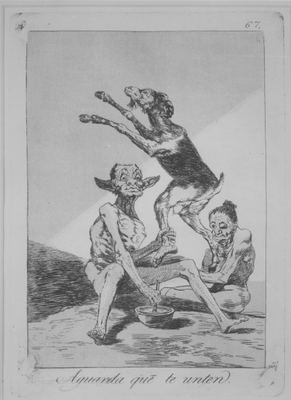
The full album entry notes that solving it together with the separate single-sheet Caprichos prints reveals the flow of the series. The image the museum has posted as its representative is plate 67, Wait till you’ve been anointed. Two goblins sit with a goat between them. It depicts the superstition that witches rub ointment on their bodies before flying off.
The night streets of Madrid
The first part of the series takes aim at the night customs of Madrid.
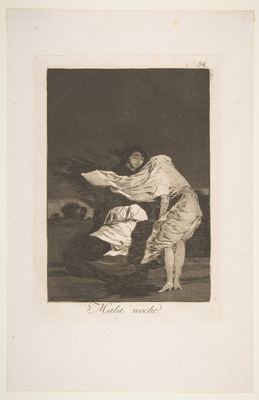
The scene described at the very start is A bad night (plate 36). Through women on a night street battered by the wind, it mocked the night customs of Madrid at the time. The contrast between the black night made with aquatint and the white clothes explains nearly the whole print.
In Out hunting for teeth (plate 12), a woman in front of a corpse hanging from a gallows covers her face with one hand and reaches the other toward the corpse’s mouth. It is said to mock the superstition that a hanged man’s teeth make a love charm. The satire is all in that posture: turning her head away in fear while still reaching out her hand.
Satire that borrows the names of myth
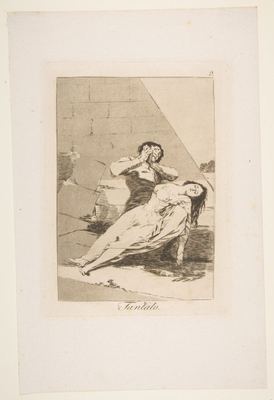
In Tantalus (plate 9), a man is in anguish beside a woman lying as if she has fainted. Tantalus is the figure in Greek myth punished by never being able to eat or drink the water and fruit in front of him. Goya is said to have applied this name to an old husband who cannot satisfy his young wife.
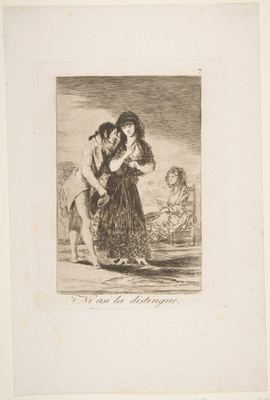
The man in Even thus he cannot make her out (plate 7) peers at a woman through a monocle held to his eye and still cannot recognize her. Only the title is etched below the plate. But a contemporary commentary handed down with the series says, in effect, that to recognize her he needs judgment more than a lens. It takes aim at people fooled by appearances.
When the old woman and the young woman return
Some plates continue with the same figures. In It is nicely stretched (plate 17), an old woman checks the fit of a young woman’s stocking, and in A pretty piece of advice (plate 15), what appear to be the same two people return, and the old woman whispers something in the young woman’s ear. This old woman is read as a procuress who appears again and again in Los Caprichos. The whisper is interpreted as advice to seduce a rich man. With scenes like these, Goya took aim at prostitution in the Madrid of his day and at the social structure that encouraged it.
The nightmare of the second half
Further on, the mood changes completely. In the second half, fantastic scenes with witches and goblins follow one after another, and the social satire of the first part continues in the form of a nightmare. In plate 78, Be quick, they are waking up, hooded figures gather around a long table. One holds a broom and one reaches for a stack of plates. They are commonly interpreted as little goblins (duendes) who finish the housework at night while people sleep and hurry off before daybreak, but because of their habit-like dress they are also seen as a satire of monks.
Following a structure that begins with social satire and ends with witches and goblins, you get the impression that Goya, who had been depicting human folly, finally finished it off with the face of a monster. It is the same painter and the same aquatint technique as the bullfight prints, but the stage is the night street and the inside of a room, far more private and darker. If the bullfight was Spain’s national spectacle, the Caprichos depicted the hypocrisy hidden behind that spectacle.
White clothes first, black areas last
Almost every plate is composed with figures in white clothes floating against a black aquatint background. Both the strategy for pictures with wide solid-color areas and the method of sorting pieces by density discussed in Degas and Lautrec drawings work here. Pieces of white clothing or white skin against the black background catch the eye at once, so use them to set up the figures’ poses first. Pieces printed with the Spanish title and number at the bottom of the print are a sure sign of the lower edge of the picture.
The black areas printed in aquatint are almost impossible to tell apart piece by piece. It is easier to finish all the figures and then fill in from the edges toward the center. On plates with two or more figures, sort by facial expression and posture. We recommend Easy (about 24 pieces) or Normal (about 48), and the wider the black areas on a plate, the lower you should set it.
Eighty of some 300
Goya is said to have left some 300 prints over his lifetime, and one group among them is the 80 plates of Los Caprichos. As you assemble several sheets in a row, the ambition of a painter who meant to satirize the whole society of an era comes through at your fingertips. While filling in the black pieces one by one, you come to think that, for Goya, that darkness was probably not simply a background.
Frequently asked questions
What is Goya's Los Caprichos?
It is a set of 80 satirical prints that Goya published in 1799. It mocked the superstition and hypocrisy of Spanish society and the corruption of the clergy and nobility, and most of the plates were made in etching and aquatint.
How is Los Caprichos organized?
The first part is social satire, such as the night customs of Madrid, and in the second half the mood shifts to fantasy, with witches and goblins.
How do you solve a Caprichos print puzzle?
Most plates are composed with figures in white clothes floating against a black aquatint background. Assemble the figures first, and fill in the black background last, the way you would handle any solid-color area.