Six 19th-Century Women's Dresses from the Islamic World: Same Cut, Different Embroidery
Published
Join rectangles of cloth, spread the sleeves wide, and cut a slit at the neck. The six garments gathered here have almost the same cut. Yet hang them side by side and the position, color, and density of the embroidery differ from one to the next, and those differences tell a different story for each garment. We covered dress from the Islamic world in Repeating patterns and Syria’s village-by-village festive dress, but six dresses did not make it into those two posts.
| Work | Material | Date |
|---|---|---|
| Dress | Cotton, metallic-thread embroidery | 19th century |
| Dress | Cotton, metallic-thread embroidery | 19th century |
| Dress | Cotton | Late 19th century |
| Dress | Cotton | Late 19th century |
| Ensemble | Wool, cotton, wood | Late 19th century |
| Vest | Silk, metallic thread, cotton | Late 19th–early 20th century |
Gold thread on a black ground
 Solve this painting as a puzzle → about 5 minutes on Easy
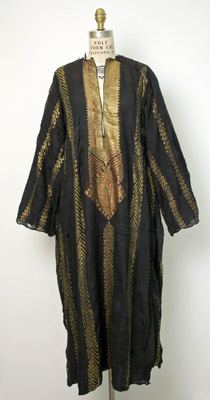
The Dress has several vertical bands of gold-thread embroidery running from shoulder to hem on black cotton. On the front of the chest is a wide panel filled in with gold thread. The vertical lines make the wearer look taller when standing, and the chest panel fills the spot on the garment where the eye goes first. The cut is the simple method of joining rectangles of cloth, so the splendor is entirely the embroidery’s doing.
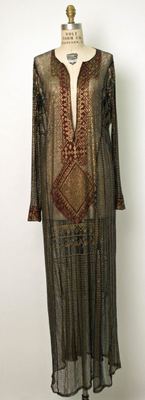
Another dress is also on a black ground, but this time it is a sheer, thin cotton. On the front panel, deeply open from neck to chest, diamonds and stripes are embroidered in red and gold thread, and fine gold patterns are scattered evenly over the body. This thin cloth was not worn as an outer garment but as one layer among several. A front panel using red and gold together is often seen in wedding dresses. In the embroidery of this region, the diamond was also used to ward off misfortune.
In the puzzle, the gold and red embroidery on both garments separates immediately from the black ground. Start with the embroidery of the chest panel or front panel, and on the one with vertical stripes, judge left from right by the spacing of the stripes.
Red embroidery on a cream ground
The other two dresses are cream cotton.
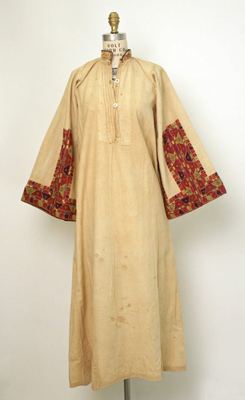
One has red embroidery only at the cuffs and neckline. A simple rectangular cut with only the sleeves spread wide is the basic form of women’s clothing in the Middle East and the Palestine region. Concentrating the embroidery at the cuffs and neckline saves cloth and decorates the places that catch the eye when the wearer moves.
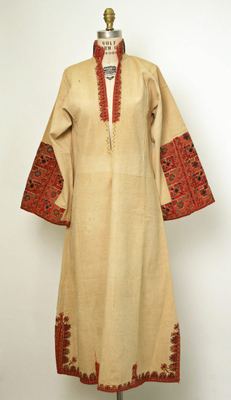
The other fills three areas, the neckline, the sleeves, and the hem, with red cross-stitch geometric patterns. This is the best-known feature of women’s clothing in the Palestine region, and the kinds and arrangement of patterns differed from village to village. Girls stitched this embroidery over several years before marriage, and it was the most important part of the trousseau.
The collection records of these two dresses do not differ by a single word in material, size, or how they were donated. They appear to be two dresses given together by the same person, but the placement of the embroidery shows they are clearly different garments. The records alone cannot tell them apart; the difference shows only when you look at the actual embroidery.
When assembling, fill in the places where the embroidery is concentrated (neckline, sleeves, hem) first. Find homes for the remaining cream pieces by the outline of the mannequin and the folds of the garment.
One outfit in several pieces
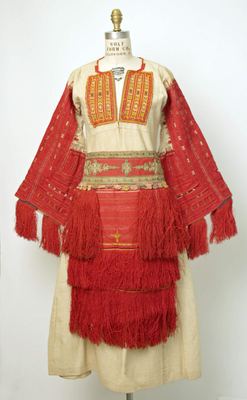
The Ensemble is not a single dress but one outfit made up of several pieces. Over a white cotton undergarment is a red embroidered vest, and around the waist is an apron hung with three tiers of red thread tassels. An outfit pairing a long tasseled apron with an embroidered vest can be seen in women’s festive dress in many parts of the Balkan Peninsula. The apron’s tassels sway when the wearer walks, bringing the movement to life, and red is the color of weddings and feasts. Another advantage of such clothing is that each piece could be handed down separately or newly made to complete the set.
The white undergarment and the red tassels divide broadly by color, so assembling the embroidery of the vest and the belt first sets the top-to-bottom structure.
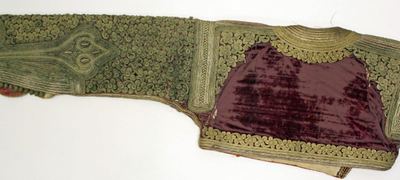
Only the decorated parts of the Vest remain: sleeve panels densely embroidered with greenish metallic thread and a purple velvet chest panel. A section with metallic thread laid this densely was the most valuable part of a garment, so when the garment wore out, this part alone was cut off and kept, or moved onto a new garment. It is a case of the embroidery outliving the garment. In the puzzle, you only need to divide it into two zones: purple velvet and green metallic thread.
For piece count, 100 pieces suits a garment with dense embroidery, and 48 pieces suits one where the embroidery is concentrated in narrow areas.
What the cut cannot say
After seeing the six garments, it becomes clear that the cut of women’s clothing in this region barely changes. What changes is only the color, position, and density of the embroidery, yet those small differences tell everything about region, class, and use. If an embroidered sampler was a way of leaving the embroiderer’s name, the embroidery on these garments was a way of saying what the cut could not.
Men’s clothing from the same region is covered by shape in Islamic-world tops, sorted by form, and related headwear is in Things worn on the head. All six are by unknown artists. Even so, there were hands that each plied the needle differently within the same frame, and the time those hands put in remains in the garments as it was.