Faces Inside a Pocket Watch Lid: Four Portrait Miniatures on Ivory
Published
When you are piecing together a face enlarged to fill the screen, it is easy to forget that the original is smaller than your palm. Four portraits in the European Paintings section were painted not on canvas but on small ivory plaques. The museum classifies all of them as “Miniatures.” They are portrait miniatures of the kind fashionable in France from the late 18th to the early 19th century, and they measure only about 6 centimeters across.
| Work | Artist | Date | Size |
|---|---|---|---|
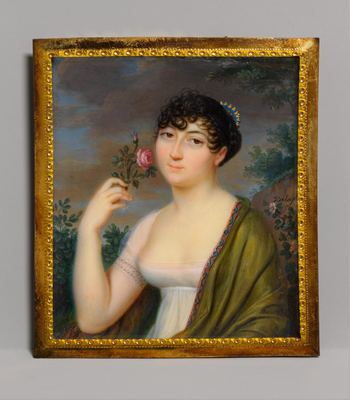
| Portrait of a Woman (white dress) | Jacques Delaplace | ca. 1805–10 | 64 × 55 mm |
| Portrait of a Woman (blue dress) | Frédéric Dubois | Active 1780–1819 | 66 mm diameter |
| Portrait of a Woman (with a hat, black and white) | Augustin Dubourg | 1758–1800 | 60 mm diameter |
| Portrait of a Woman, Said to Be Madame Récamier | Nicolas François Dun | ca. 1812–14 | 60 × 48 mm |
Portraits like these were not hung on walls. People wore them around the neck or kept them inside the lid of a pocket watch, and sometimes pressed them into the other person’s hand before a parting.
A rose in 5.5 centimeters
 Solve this painting as a puzzle → about 5 minutes on Easy
In Jacques Delaplace’s Portrait of a Woman, a woman with her black curls pinned up wears a white dress with a green shawl and holds a pink rose. The original ivory plaque is 5.5 centimeters wide. It is far smaller than what you see on the screen, so you only see the details once the puzzle enlarges it.
The dress is the high-waisted style fashionable in France under Napoleon’s Empire. Its use is even more striking. Such portraits were given to someone before a marriage or a parting, and sometimes a lock of hair was placed behind the frame. Jacques Delaplace is said to have been a Paris painter who specialized in miniatures like this, but there is no record of who the woman in the picture actually is.
A pendant that kept its gold frame and blue glass
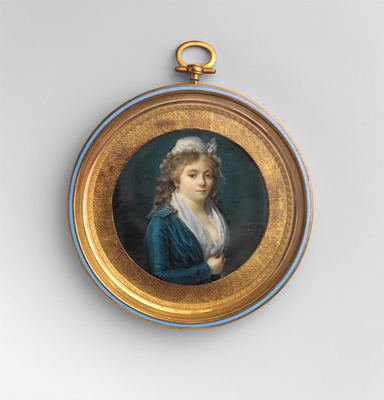
Frédéric Dubois’s Portrait of a Woman shows a woman in a white head scarf on a round ivory plaque. Dubois was a miniaturist active around the time of the French Revolution, and round portraits like this were carried in pocket watch lids or pendants.
This one actually still has its engraved gold frame and blue glass border, with a loop on top as well. It survives not just as a picture but in its original piece of jewelry. Its date is estimated from the clothing, which matches the fashions of the 1790s.
A ribbon in a photograph without color
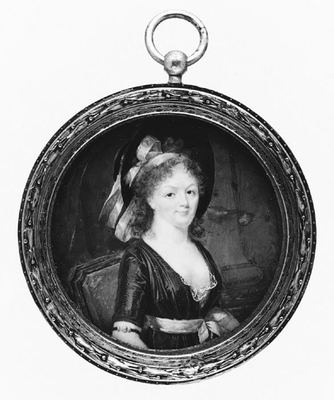
Augustin Dubourg’s Portrait of a Woman shows a woman in a large beribboned hat with her curls falling loose. The museum’s image is black and white, but the hat and hairstyle were fashionable in the late 1780s, which lets us estimate the date. Few works by the painter Augustin Dubourg survive.
Even without color, there is still plenty to read. The ribbon on the hat, the sheen of the dress, and the soft shading of the face are all intact. Shape and shading alone are enough to convey both the fashion and the painter’s skill.
The rumor of Madame Récamier
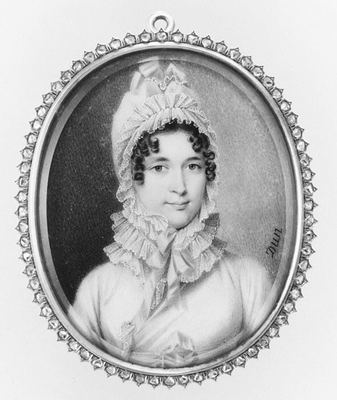
The Portrait of a Woman, Said to Be Madame Récamier (1777–1849) is an oval portrait of a woman in a white lace bonnet. Juliette Récamier was the most celebrated woman in Parisian society in the Napoleonic era, widely known through portraits painted by David and Gérard.
Someone that famous is just the kind of person whose name gets attached to a picture. But whether the figure in this small painting is really her is only hearsay and has not been confirmed. A famous name attached to a picture cannot simply be taken at its word. The painter, Nicolas François Dun, was a French miniaturist who worked in Naples, and he painted the lace and curls meticulously with a fine brush.
Not one of the four sitters has a confirmed identity. Even Madame Récamier is only “said to be.” Yet from clothing and hairstyles alone, the dates can be pinned down quite closely, from the 1780s to the 1810s. The names have vanished; the fashions remain. It is a situation much like that of the nameless royal sculptures.
Faces first, then follow the curve of the frame
Because the ivory plaques are enlarged so much, the delicate brushwork of the miniatures shows on every large piece. Following the basics of the portrait puzzle guide, fit the face and headwear pieces first to fix the figure’s position. The gold frames and glass borders around the edges are curves, so judge positions from the direction they bend. The white lace and folds of ribbon have a different grain on each piece, which makes them easy to tell apart. For a picture without color, like the hat portrait, sort pieces by brightness; the density-sorting method covered in Drawings by Degas and Lautrec works here too. The originals are small, so Easy (about 24 pieces) or Normal (about 48) is the right size.
If a large portrait is a picture hung on a wall for many people to look at over time, these miniatures were pictures one person carried on the body. If Drouais’s Parisian women represent the side of portraiture that records social standing, these four show how private and intimate a portrait could become. People in 18th- and 19th-century France hung faces on their walls and also kept them in their pockets. When you think of a watch lid opened and closed countless times in someone’s palm, these small faces look rather tender.