Klimt, Modigliani, Rousseau, Turner: How Four Paintings Differ as Puzzles
Published
Turner in London in 1835, Rousseau in Paris in 1907, Klimt in Vienna in 1913, Modigliani in Paris in 1919. These four paintings have never hung together. Their eras and cities differ. We put them side by side anyway because each of the four slipped away, in its own direction, from the standard of its time for what a painting ought to be. One melted form into light, one invented a jungle its painter had never seen, one stood a child up like an adult, and one erased the pupils of the eyes. You can read this as a sequel to Painters against type.
| Work | Artist | Date | As a puzzle |
|---|---|---|---|
| Venice, from the Porch of Madonna della Salute | Joseph Mallord William Turner | ca. 1835 | Bright, pale colors; hard |
| The Repast of the Lion | Henri Rousseau | ca. 1907 | All green, yet surprisingly manageable |
| Mäda Primavesi | Gustav Klimt | 1912–13 | Lots of pattern; most fun at 100 pieces or more |
| Jeanne Hébuterne | Amedeo Modigliani | 1919 | Broad color fields; suits fewer pieces |
Turner’s Venice, while the buildings are still visible
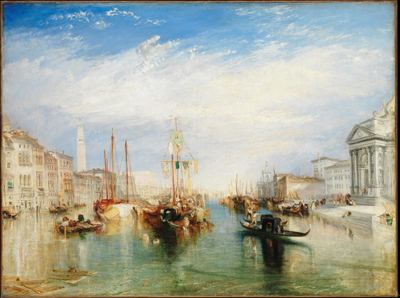 Solve this painting as a puzzle → about 5 minutes on Easy
In Venice, from the Porch of Madonna della Salute, the Grand Canal opens out beyond white marble columns in the right foreground. Black gondolas and sailboats float on the water, and palaces and bell towers line both banks. The sky is a bright cream, and the water takes in that sky and reflects it back. Turner painted this after his second trip to Venice in 1833 and showed it at the Royal Academy in London. It dates from the period when he was moving into the late style that melts form into light, so the buildings and boats are still recognizable. Only a few years later, Turner’s Venice would become a mist of color.
This is the hardest of the four. Most of it is bright, pale color, so first grab the pieces that stand out: the black gondolas, the white columns, the red sails. Connect the buildings into a waterfront using the dots of their windows and their rooflines. Sky and water are almost the same color, so the trick is to fix the horizon first, which is the bottom line of the buildings, and then divide above from below.
The jungle Rousseau built in a botanical garden
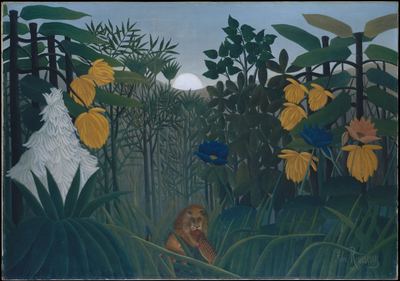
In The Repast of the Lion, broad-leafed trees and flowers crowd the picture, and at the bottom center a lion bites the neck of a spotted animal. Every leaf has a crisp outline, and the greens split into dozens of layers. Somehow the lion’s expression looks mild.
Rousseau worked at the Paris customs office and taught himself to paint after the age of forty, and he never went to a jungle. He built his jungles from the greenhouses of the Paris botanical garden, magazine illustrations, and stuffed animals at the zoo. The art world laughed at him, but Picasso and Apollinaire threw a banquet in his honor. The lion and jaguar in this painting came from a book of animal photographs he liked to look at.
Since it is all green, you might think sorting by color would not work, but once you try it, every leaf differs in shape and color, so the pieces are easy to tell apart. First grab the pieces that stand out, such as the lion and its prey, the red sun, and the flowers, then connect the leaves by the direction of their veins and the curves of their edges. The fact that the greens grow darker toward the bottom is another clue.
The resolute face of nine-year-old Mäda
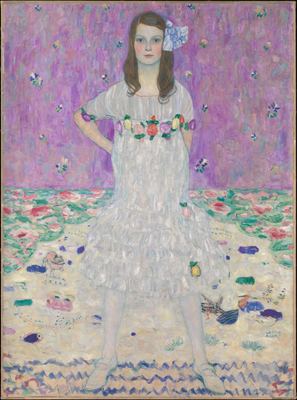
In Mäda Primavesi (1903–2000), a girl in a white dress with a lilac sash stands with her legs apart and her hands behind her back, looking straight ahead. Her expression is as resolute as an adult’s. Behind her are a wall with a pink and lilac floral pattern and a green carpet, and at her feet lies a rug with an animal pattern. The background pattern is flat, while only the girl’s face and hands are modeled in three dimensions.
It depicts Mäda, the daughter of Otto Primavesi, a Viennese banker and patron of Klimt, and it is the only full-length portrait of a child that Klimt painted. Mäda was nine at the time. She later recalled that Klimt made dozens of sketches while settling on the pose. He did not paint the child as cute or docile; he stood her up as a person with a will of her own. Mäda lived to ninety-six, dying in 2000.
First divide the picture into the white dress, the pink background, and the green floor, then place the floral background pattern by the color and size of the flowers. Follow the white dress pieces along the direction of the folds. With so much pattern, 100 pieces or more is actually more fun, and it is also a good choice for taking on 300 pieces.
The eyes Modigliani left empty
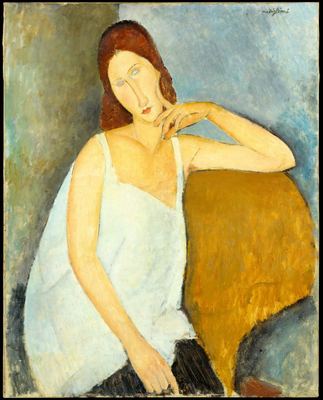
In Jeanne Hébuterne, a woman with her reddish-brown hair pinned up sits with her head tilted slightly. Her neck is elongated, her face is narrow, and her eyes are painted blue with no pupils. Every line curves softly.
Jeanne Hébuterne met Modigliani in 1917 at the age of nineteen and became his lover and muse, and he painted her more than twenty times. When Modigliani died of tuberculosis in January 1920, Jeanne took her own life two days later. There is a story that, on not painting pupils, Modigliani said, “When I know your soul, I will paint your eyes.” He painted this picture the year before he died.
The forms are simple and the color fields broad, so with few pieces it is easy, and with many the background makes it hard. First connect the outline pieces of the face, hair, and neck to stand the figure up, then fill in the background using the boundary between ocher and gray as your guide. The order in the portrait puzzle guide fits exactly.
Once you have finished all four, you realize that one technique will not do. Turner yields to standout colors, Rousseau to shapes within a single color, Klimt to pattern, and Modigliani to outline. Just as each painter departed from the standard in a different direction, the way your hands find their way into each painting is different too. What happened in Paris a generation before these painters can be seen in Seven paintings: the Impressionists and after.
Frequently asked questions
What kind of painting is Klimt's Mäda Primavesi?
It depicts the nine-year-old daughter of the Viennese banker Otto Primavesi and is the only full-length portrait of a child that Klimt painted. It is notable for presenting the child not as cute or obedient but as a person with a will of her own. Mäda lived to the age of ninety-six, dying in 2000.
Why didn't Modigliani paint pupils in the eyes?
There is a story that he said, "When I know your soul, I will paint your eyes." Jeanne Hébuterne is a portrait of Jeanne, his wife and last model, painted in 1919, the year before he died.
Which of the four paintings is hardest as a puzzle?
Turner's Venice. Most of it is bright, pale color, so you need to grab the pieces that stand out, such as the black gondolas, white columns, and red sails, fix the horizon, and then separate sky from water. Rousseau's all-green jungle is actually easier, because every leaf has a different shape.