Why Paint the Tragedy of Lucretia on a Wedding Chest?
Published
On the chest a bride carried with her when she married, someone painted the story of a woman who was raped and took her own life. Seen today, it is a puzzling combination. That is the case with two panels in the Robert Lehman Collection, The Rape of Lucretia and The Funeral of Lucretia.
The cassone, a chest for a bride’s trousseau
A cassone was the wooden chest in which a bride in Renaissance Italy carried her trousseau. The front of the chest was usually decorated with painting, and these two panels are such fronts. They are long, around 70 centimeters wide, and low, a little over 40 centimeters tall, because they follow the proportions of a chest’s front board.
The museum records list both panels as tempera and gold on wood by a painter “active in Florence, late 15th–early 16th century.” No name survives. Art historians call this painter the “Master of Marradi” and consider him a specialist in painting chests like these.
One woman’s death brings down a monarchy
Lucretia, a Roman noblewoman, took her own life after being raped by a prince. Citizens enraged by her death overthrew the monarchy. It is a brief episode, but in Renaissance Florence it was received as a story symbolizing the republic. The two panels divide the story into before and after.
 Solve this painting as a puzzle → about 5 minutes on Easy
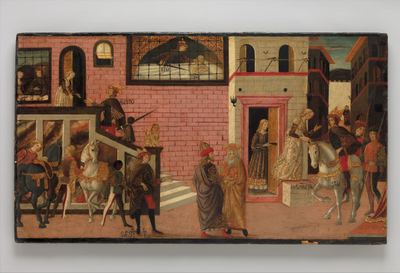
The setting of The Rape of Lucretia is a palace of pink brick. On the left are mounted soldiers and a staircase, a woman stands inside a doorway in the center, and on the right are a man on a white horse and soldiers. Small figures also appear in the upper windows. The act itself is not shown. The painting lets you infer the story from the palace as a stage and the people placed inside and around it.
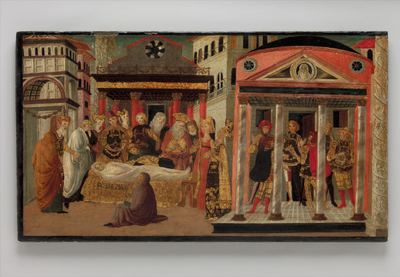
On the left of The Funeral of Lucretia, a woman lies on a white bed with people gathered around her. On the right, in a temple lined with columns, men are talking. This is presumably the moment when Brutus urges the citizens to overthrow the monarchy. This panel holds the point where one person’s death spreads into a political event.
Why this story for a bride
Put the two panels side by side and they form the front of a single wedding chest. By today’s standards, this is hardly a bright subject suited to a wedding gift. But cassone paintings in Renaissance Florence were also models held up to the bride. They are said to have aimed to teach both a wife’s chastity and a citizen’s courage.
Lucretia was a symbol of the woman who gave her life to preserve her chastity. The outcome her story brought about, the fall of the monarchy and the beginning of the republic, was also a part of their own history that Florentines took pride in. The bride would have carried this chest to her husband’s home and lived with the story in front of her every day.
A painter without a name who painted only chests
The “Master of Marradi” is not a real name. It is a conventional name art historians use to group paintings in a similar style, and Marradi is a place near Florence.
Cassone painting formed a separate branch of the painting market of the time. Unlike altarpieces or portraits, these were part of a piece of furniture, so they were often produced several at a time in specialist workshops. That may well be why no name survives.
Dividing the picture with rows of brick and columns
In both panels, buildings divide a very wide picture. In The Rape, the windows and door frames of the pink brick palace cut the picture at regular intervals; in The Funeral, the columns of the temple on the right do the same. Assemble these straight-edged pieces first and the picture sorts itself into a few zones.
The rows of pink brick run at even intervals, so use their height to judge up and down. The figures are small and scattered, so you have to find their places one by one, comparing the colors of their clothes with the preview. The blue sky at the top is wide and plain, so fill it in last, after everything else is done. Because the pictures are long and wide, the grid comes out flat, and 100 pieces suits both.
Two pictures apart, one story together
Seen one at a time, these two panels are separate paintings, but placed side by side they become a single story. Other paintings from the same era painted in tempera on gold ground are in saint paintings on gold ground. Seen together with the Bernardino portraits, in which the same collection has one saint painted three times, they give a sense of the range of the Robert Lehman Collection. How to read paintings drawn from literature and myth is covered further in paintings from books and myths.
The chest is gone, and only its front boards remain, hung on a museum wall. No record tells us how the bride, who would have lived with that story every day, felt as she looked at these pictures.