Hamlet, Don Quixote and the Amazons: Masterpieces from Literature
Published
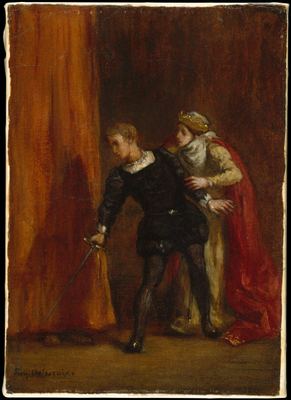
A young man in black, his sword point lowered, glares at a red curtain. Someone who knows the story reads an event in this scene; someone who doesn’t simply sees a picture of two people quarreling. Museums hold many paintings like this that render a single scene from a story. We picked a few European paintings that come from books or myth: Shakespeare’s Hamlet, Cervantes’s Don Quixote, and the Amazons of Greek mythology.
The Body Fallen Behind the Red Curtain
 Solve this painting as a puzzle → about 5 minutes on Easy
Hamlet and His Mother is a small oil painting, 27 centimeters high, painted by Eugène Delacroix (1798–1863) in 1849. According to the museum’s information, it came in 1967 through the bequest of Adelaide Milton de Groot.
Behind the man mentioned at the start, a woman grips his arm. This is Hamlet, Act 3, Scene 4, just after Hamlet, in his mother’s chamber, has stabbed Polonius, who was hiding behind the curtain to eavesdrop. You can see the picture without knowing the scene. But once you know what led to the body fallen in the darkness beneath the curtain, the two faces read differently.
After seeing an English company perform Shakespeare in Paris in the 1820s, Delacroix was preoccupied with Hamlet for the rest of his life. Beginning in 1834, over more than a decade, he produced a series of Hamlet lithographs, and this small oil repaints one scene from that series. He returned to the same story again and again, in prints and in oils.
In the puzzle, the black clothing, the red curtain and the white head covering divide the picture into large areas. Gather the pieces with clear shapes first, such as the two figures’ faces and hands and the sword. The red expanse of the curtain on the right is wide and confusing, but it darkens from top to bottom, so divide it vertically as you assemble it. The picture is small, so 24 or 48 pieces is about right.
Don Quixote, Invited to a Modest Room After a Wedding
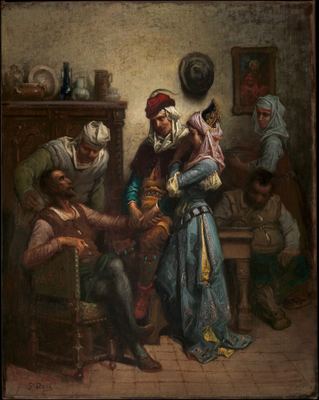
Don Quixote and Sancho Panza Entertained by Basil and Quiteria is an oil painting by Gustave Doré (1832–1883), 92 centimeters high and 73 centimeters wide. The museum’s date is “1863?”, with a question mark.
In 1863 Doré drew hundreds of illustrations for Don Quixote, all but fixing how the novel is pictured. The scene in the painting is the episode in which Basil, who has won the bride Quiteria by a ruse at the wedding of the rich Camacho, invites Don Quixote and Sancho to his home.
What deserves attention is that an illustration was carried over into oil. Doré’s illustrations are known for their black-and-white line, so you can compare how the same scene changes once it takes on color. The illustration is not here, so to compare you will need to look up Doré’s illustration separately.
The blue clothing, the red cap and the white head cloth are clear spots of color, so reference points are easy to find. Assemble the figures’ faces first, set up the top frame with the straight lines of the cupboard and the frames on the wall, then fill in the brown floor and walls. 100 pieces is about right.
Two Amazon Paintings by a Nancy Court Painter
Triumph of the Amazons and Departure of the Amazons were painted in the 1620s by Claude Déruet (ca. 1588–1660), a painter from Nancy, France. At 51.4 × 66 cm and 50.8 × 66 cm they are nearly the same size, and both came in 1971 through the bequest of Harry Sperling.
The Amazons are a tribe of women warriors in Greek mythology. Déruet worked in Nancy as court painter to the Duke of Lorraine, painting lavish festival pictures and mythological scenes. The two works are a pair, and read as having been painted to hang side by side: a scene of setting out to battle and a scene after victory.
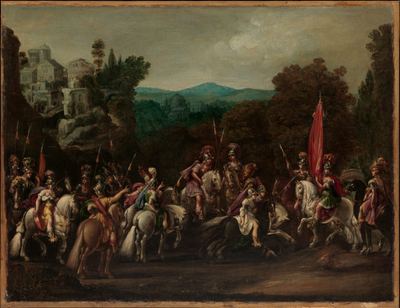
In Departure, mounted women warriors file out along the edge of a forest below a fortress.
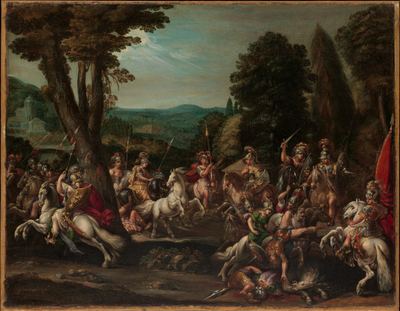
In Triumph, the warriors crowd together beneath a large tree, spears raised.
Déruet took more care over the ornament of horses and armor and the way the figures form groups than over the cruelty of battle. The taste of the court shows plainly. The mood is closer to a splendid court cavalcade than to warriors of myth, so even while painting a story, the painter’s eye seems to have been on the court he served.
Both works offer plenty of clues. For Triumph, assemble the two white horses, the red banners and the large tree trunk on the left first. Departure divides into zones: the fortress and rocks on the left, the blue mountains and sky at upper right, and the group of riders below. The figures are small and numerous, so they are worth trying at 300 pieces. If a large board is new to you, it helps to read Taking On 300 Pieces for the First Time first.
A Picture That Reads Anew Once It Is Done
Story paintings are more interesting after you finish them. Only when every piece is in place and the whole picture appears can you lay it over the scene in the story. For Hamlet, the question “What happened just before this moment?” comes to mind; for Don Quixote, “Why have these people gathered here?” Tips on looking at figures’ faces at length are in the portrait puzzle guide, and ways of looking at paintings through puzzles in general are covered in Learning to Look at Art Through Puzzles.
You can solve the puzzle without knowing the story. But if you look up the story and read it after you finish, the picture you just put together piece by piece reads anew once more.