Saint Bernardino, Painted Three Times by Sienese Artists
Published
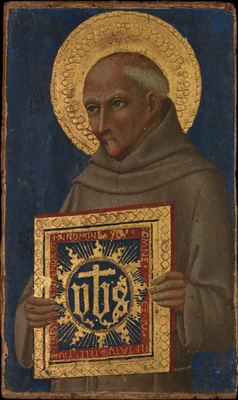
A gaunt old man in a brown habit holds a tablet inscribed with the letters IHS. There are three paintings with the same title, Saint Bernardino, and at first it is easy to assume they are all alike and move on. But the longer you look at them side by side, the more the differences stand out. All three were painted by artists from Siena, Italy, and all three came to the museum from the Robert Lehman Collection in 1975.
| Work | Painter | Date | Size |
|---|---|---|---|
| Saint Bernardino (blue background) | Sano di Pietro | ca. 1460–70 | 17.8 × 10.5 cm |
| Saint Bernardino (gold background) | Sano di Pietro | 1447 (presumed) | 24.1 × 22.2 cm |
| Saint Bernardino (garland) | Benvenuto di Giovanni | ca. 1474 (presumed) | 23.8 × 25.7 cm |
 Solve this painting as a puzzle → about 5 minutes on Easy
The first is a small panel about 18 centimeters high that fits in the palm of your hand. At this size it may have been less a picture to hang on a wall than one a person kept nearby for prayer. That is a guess based on size alone; where it was actually placed has not been confirmed.
The Preacher Who Held Up the IHS Tablet in the Square
Bernardino was a Franciscan friar who traveled the cities of Italy in the first half of the 15th century, preaching in their squares. He was famous for carving the IHS monogram, which stands for the name of Jesus, on a tablet and holding it up to the crowds.
He is said to have died in 1444 and been made a saint in 1450. If so, the picture from around 1447 was painted before he was officially canonized, yet it has a halo. That may show how early the people of Siena regarded him as a saint. But the date of that picture itself carries a question mark, so this inference should be read with caution.
Same Composition, Different Mood
All three pictures share the composition of an old man in a brown habit holding the IHS tablet. Yet the impressions they give are quite different.
The small portrait on the blue background has clear colors. The brown habit, the red tablet and the gold halo separate sharply against the blue background. The gaunt face stays with you; since it was painted while the memories of people who had seen Bernardino in person were still alive, it can be seen as close to his actual appearance.
Because its colors are so distinct, it is also the easiest as a puzzle. Assemble the face, the IHS tablet and the gold pieces of the halo first, and the remaining blue background falls into place on its own. If you are new, 24 pieces is enough.
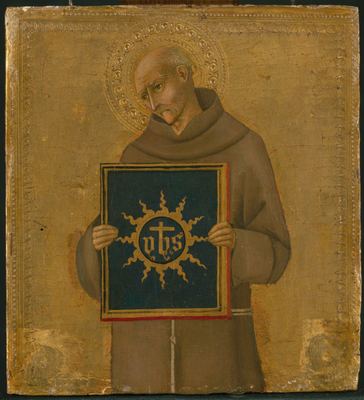
In the gold-background version, the background is gold all over. The halo has a pattern made of punched dots, and scratches remain on the surface. It is a typical example of the gold-ground paintings covered in Renaissance gold panel paintings.
This one, by contrast, is tricky. Most of the background is gold, so the pieces look much alike. First separate the pieces with the halo’s dot pattern from those without, set up the center with the blue tablet, the face and the brown habit, then fill in the gold leaf from around the halo outward. It is the same method as in the gold panel painting puzzle guide, and we recommend 48 pieces.
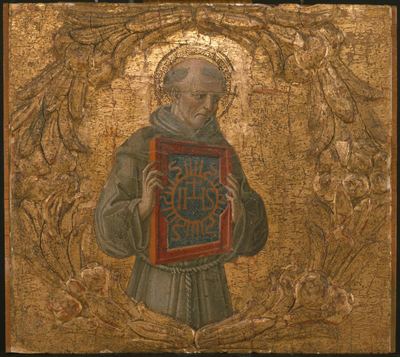
The portrait with the garland is the most distinctive of the three. A garland woven of leaves and fruit encircles the figure, and the museum’s medium field reads “pastiglia fruit garland.” Pastiglia is a technique in which gesso is built up in several layers and then gilded. So this garland is not painted but a raised relief. If you ran your hand over the surface, only the garland would feel bumpy.
In the puzzle, the shadows that raised surface casts are your clue. Garland pieces have shading; flat gold-leaf pieces do not. The picture is nearly square, so it does not matter where you start. Run the garland around as a circle first and the frame is set, and the figure settles naturally inside it.
Likeness, Gold Leaf, Ornament
Even for the same saint, different painters honor him in different ways. One brought out the likeness of his face, one put holiness forward through gold leaf, and another surrounded him with a garland like a commemorative plaque. Since they depict the same saint, solving them one after another lets you grasp the difference with your hands. Basic tips for portrait puzzles are in the portrait puzzle guide, and Madonna and Child paintings from the same era can be seen in Madonna and Child puzzles.
Once you have finished all three boards, the differences between the people who painted the same face three times stay in your hands. Five hundred years ago, the people of Siena each wanted a different picture even of a single saint. Three scattered heaps of pieces tell you so.