Neri di Bicci Painted Tobias and the Angel at Two Prices
Published
A winged angel walks along holding a boy by the hand. They are the Archangel Raphael and the boy Tobias. The Robert Lehman Collection has this scene in two sizes. According to the museum records, both were painted in tempera and gold on wood by the 15th-century Florentine painter Neri di Bicci (1419–1491), and both entered the Robert Lehman Collection in 1975.
The boy who caught a fish
The two paintings tell the same story. In the Book of Tobit, from the Old Testament Apocrypha, the boy Tobias sets out on a long journey guided by the angel Raphael, catches a fish, and cures his father’s eyes with its gall.
What the painting was used for is even more interesting. In 15th-century Florence, families sending a son far away are said to have commissioned this painting to pray for his safe return. In today’s terms, it was a kind of talisman parents hung up for a child leaving to study abroad or on a long trip.
The large version and the small version
| Work | Size | Features |
|---|---|---|
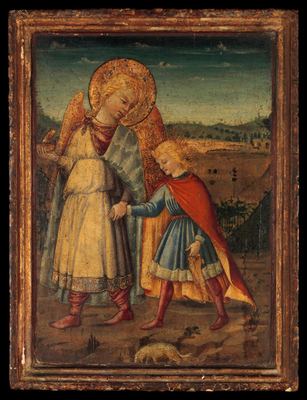
| Large version | 30.2 × 23.2 cm | Red robe and white cloak, no dog |
| Small version | 19.7 × 14.6 cm | Pink robe, dog included, starry background |
Side by side, the details differ quite a bit.
 Solve this painting as a puzzle → about 5 minutes on Easy
In the large version, an angel in a red robe with a white cloak walks holding the hand of a boy in a blue robe with a red cloak.
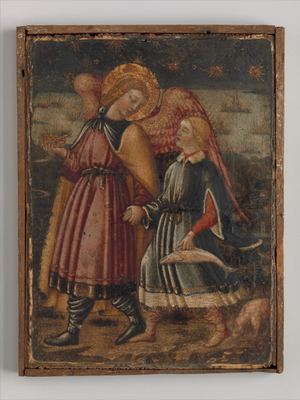
The angel in the small version wears a pink robe and has red wings, and the boy is dressed in white with striped sleeves. The colors of the clothes, the color of the wings, and the background all differ.
The most noticeable difference is the dog. The small version has a little dog following behind, but the large version does not. It is the dog that set out with Tobias in the Book of Tobit. The painter put the dog from the original story into one version and left it out of the other.
Why paint the same picture twice
Neri di Bicci made and sold several versions of subjects popular in Florence, at different sizes and prices. The small version may have been for a patron of somewhat more modest means.
Seen with today’s eyes, it is not so strange. It is like offering a best-selling product at several price points. Neri di Bicci was a workshop painter who worked actively in Florence, and he may well have reused the same underdrawing or composition while adjusting the size and the amount of gold leaf to the patron’s budget. The fact that the large version is bigger and has a more ornate gilded frame lends weight to that guess.
The Bernardino portraits, one saint painted three times, are in the same collection. Neri di Bicci’s Tobias is smaller in scale but shows the same principle. A popular subject was not painted just once.
Start with the joined hands
In both paintings the figures are in the center of the picture and the background is relatively simple. The hands joined by the angel and the boy are the pieces that connect the two figures, so finding them first establishes the center of the picture. The large version divides clearly into red and blue robes, the small version into pink and white, so sorting by color is quick. The fish beside or at the feet of the boy is small and easy to miss. It is the key element of the story, so look for it carefully.
Treat the background differently in each painting. The large version is a landscape spread with hills, a river, and a town, so the tips in how to choose landscape puzzles apply. The small version has gold star dots scattered over a dark ground, so the approach described in the gold panel painting puzzle guide suits it better. Both are small paintings, so 24 or 48 pieces is about right. Solve them side by side and you can feel at your fingertips the difference between two treatments of the same subject.
Two paintings carrying the same promise
Seen together, the two paintings call up a scene in some 15th-century Florentine household. There are parents who must send their son far away, and they commissioned a large or a small painting to suit their means. The paintings differ in size, but the promise carried by the angel and the boy is the same: that the one who has set out will return safely. It was a scene repeated again and again in the painter’s workshop, but each household that received a painting was waiting for one son of its own.