What Is Perspective in Art? Vanishing Points, Linear and Atmospheric Perspective Made Easy
Published
Perspective is a way of showing near and far on a flat surface. It starts from drawing near things large and far things small, and divides into linear perspective, which gathers the parallel lines of roads and buildings to a single point, and atmospheric perspective, which paints distant mountains paler and bluer. If a road in a painting seems to be sucked away into the distance, perspective is at work.
Linear perspective and the vanishing point
Stand in the middle of a railway track and look into the distance, and the two parallel rails seem to narrow until they meet at a single point. This point is called the vanishing point. It always sits at the viewer’s eye level, that is, on the horizon line. Draw the parallel lines in a picture so they gather at the vanishing point, and depth appears. This is linear perspective.
The first person to demonstrate this principle with an experiment was the Florentine architect Filippo Brunelleschi in the early 15th century. Around 1415–20, it is said, he painted the Florence Baptistery on a panel in perspective and, through a small hole drilled in the panel, let viewers look back and forth between the painting reflected in a mirror and the real building. In 1435 Leon Battista Alberti set it out in On Painting as a method painters could use. From then on, perspective became a basic skill of Renaissance painting.
Atmospheric perspective: paler and bluer with distance
Distant mountains look paler and bluer than near ones, because of the air in between. Carrying this into painting is atmospheric (or aerial) perspective. Leonardo da Vinci described the effect in detail in his notebooks. In a landscape without lines, such as ranges of mountains or the sea, atmospheric perspective tells you the distance better than linear perspective does.
Perspective in masterpieces
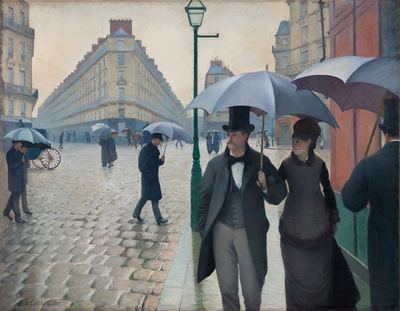
- Caillebotte, Paris Street; Rainy Day (1877): The wedge-shaped building at the left recedes into the distance, and the joints of the paving stones and the rows of windows all converge far away. It is the painting in which you can see linear perspective most clearly.
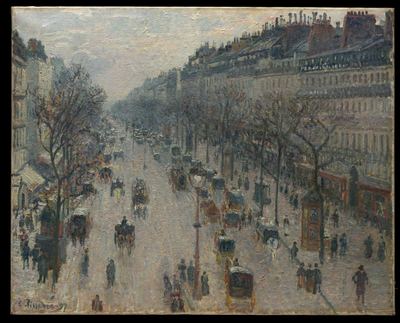
- Pissarro, The Boulevard Montmartre on a Winter Morning (1897): Seen from a high hotel window, the boulevard narrows to a single point far away, following the buildings and trees on either side. The brushwork is loose, but the lines of the street converge precisely.
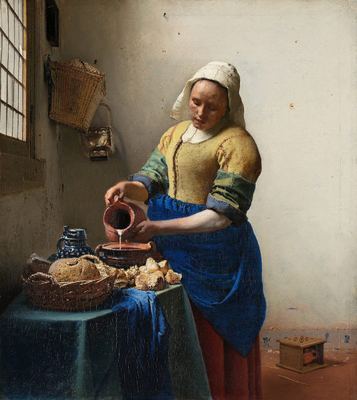
- Vermeer, The Milkmaid: A narrow room lit by a single window is painted in perspective. In several of Vermeer’s paintings a tiny pinhole remains at the vanishing point, taken to be the trace of a pin stuck in with a string tied to it and pulled taut to draw the lines.
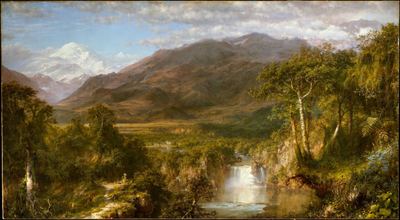
- Church, Heart of the Andes (1859): The leaves and birds in front are crisp one by one, the valley in the middle sinks into mist, and the snow-covered peak of Chimborazo at the top glows faintly. It is a textbook example of atmospheric perspective.
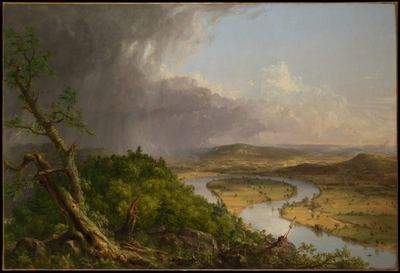
- Thomas Cole, The Oxbow (1836): The rocks and broken tree in front are dark, and the winding river and the distant farmland grow paler and paler. The story of American landscape painting is told separately in six American paintings.
Methods other than perspective
Perspective is not the only right answer.
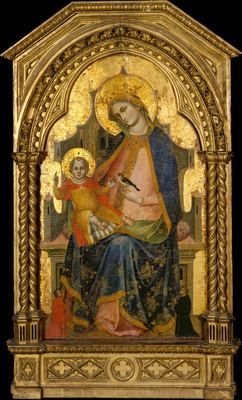
- Make the important things large. The gold-ground altarpieces of Europe before perspective set size by importance rather than distance. In Lorenzo Veneziano’s Madonna and Child Enthroned with Two Donors, the donor couple kneeling at the Virgin’s feet are far smaller than she is. Painting the people who commissioned the picture small was the custom of the time. The gold ground makes a shining flat surface in place of depth.
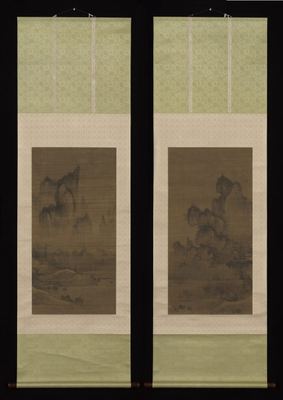
- The “three distances” of East Asian painting. The Northern Song painter Guo Xi set out three viewpoints for looking at mountains: high distance, looking up from the foot of a mountain to its peak; deep distance, looking from the front mountain into what lies behind it; and level distance, looking from a near mountain to far ones. Several viewpoints can mix within one painting. Evening bell from mist-shrouded temple; Autumn moon over Lake Dongting, attributed to An Gyeon, separates near mountains in dark ink from far mountains in pale ink using shades of ink alone, and erases the distance with mist. The story of the Eight Views of Xiaoxiang continues in Eight Views of Xiaoxiang and misty Joseon landscapes.
- Make near things absurdly large. In his late series One Hundred Famous Views of Edo, Hiroshige set a thick plum branch or a bridge post right at the front of the picture and drew the people beyond them very small. It is a Japanese print composition that pushes the size difference between foreground and distance to the extreme to create a sense of depth. More of the story is in what is ukiyo-e.
Finding the vanishing point in the classroom
Print Paris Street; Rainy Day or The Boulevard Montmartre on a Winter Morning, lay a ruler on it, and extend the rooflines of the buildings, the rows of windows and the edges of the street with long pencil lines. Where the lines meet is the vanishing point. Draw a horizontal line through that point and you have the painter’s eye level. Write the vanishing point and eye level you found into the analysis step of an art appreciation essay, and you get a sentence far more specific than “it seems to go on into the distance.”
Seeing perspective through puzzles
Paintings with strong perspective are good to solve as puzzles, because the direction in which lines converge tells you where a piece goes.
- Converging lines are clues. In Paris Street; Rainy Day, look at the slope of the paving-stone joints. The closer to the edge of the picture, the more steeply the lines lie.
- Tell front from back by size. Even for the same kind of person or the same row of trees, pieces where they are painted small go near the vanishing point, and pieces where they are large go at the front.
- Tell distance by paleness. In Heart of the Andes and The Oxbow, dark, crisp pieces go at the bottom, and pale, bluish pieces go at the top, in the distance.
If it’s your first time, start with 48 pieces. As you follow the lines while you fit the pieces, you naturally come to know where the painter stood to see this view. Paris paintings from the same period can be followed in order of date in seven Paris paintings from 1874 to 1897.
Frequently asked questions
What does perspective mean in art?
It is a way of showing near and far on a flat surface. The two main kinds are linear perspective, which draws parallel lines converging to a single point, and atmospheric perspective, which paints distant things paler and bluer.
What is a vanishing point?
It is the spot where lines that are really parallel, such as the two edges of a road or a railway track, seem to meet and disappear as they recede. The vanishing point sits on the horizon line, at the eye level of the person drawing.
Who invented perspective?
In the early 15th century the Florentine architect Filippo Brunelleschi demonstrated the principle of linear perspective with an experiment, and in 1435 Leon Battista Alberti set it out for painters to use in On Painting. Leonardo da Vinci wrote about atmospheric perspective in detail in his notebooks.
Does East Asian painting have perspective?
Yes. The "three distances" set out by the Northern Song painter Guo Xi are high distance, looking up at a mountain; deep distance, looking past the front mountain into what lies behind; and level distance, looking from near to far. Painting near mountains in dark ink and far mountains in pale ink is another way of creating a sense of distance.