11 Must-See Paintings at the National Gallery of Art in Washington, from Leonardo's Ginevra de' Benci to Monet's Parasol
Published
The National Gallery of Art on the National Mall in Washington, D.C., doesn’t charge admission. You can wander in between the Smithsonian museums, and there on the wall is a Leonardo da Vinci, the only one in the whole of the Americas. The museum opened in 1941, so it is younger than the Met or the Art Institute of Chicago, but thanks to the collector Andrew Mellon and the donors who followed him, it holds a dense run of masterpieces of European painting.
The museum releases images of its public domain works under CC0. Eleven of them have been turned into puzzles on this site.
| Work | Artist | Date | Size (cm) |
|---|---|---|---|
| Ginevra de’ Benci | Leonardo da Vinci | ca. 1474–78 | 38.1 × 37 |
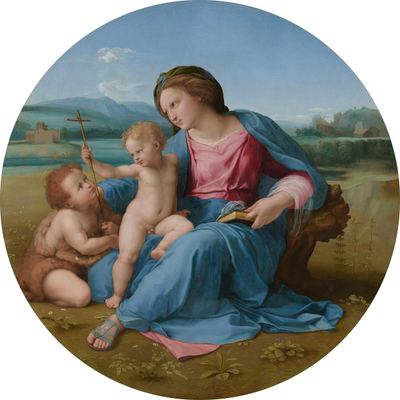
| The Alba Madonna | Raphael | ca. 1510 | round (tondo) |
| Woman Holding a Balance | Johannes Vermeer | ca. 1664 | 42.5 × 38 |
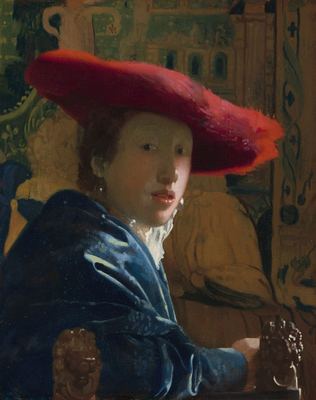
| Girl with the Red Hat | Johannes Vermeer | ca. 1669 | 22.8 × 18 |
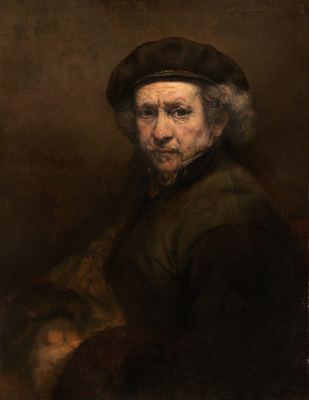
| Self-Portrait | Rembrandt | 1659 | 84.5 × 66 |
| Symphony in White, No. 1: The White Girl | James McNeill Whistler | 1861–63, 1872 | 213 × 107.9 |
| Woman with a Parasol - Madame Monet and Her Son | Claude Monet | 1875 | 100 × 82 |
| A Girl with a Watering Can | Pierre-Auguste Renoir | 1876 | 100 × 73 |
| La Mousmé | Vincent van Gogh | 1888 | 73.3 × 60.3 |
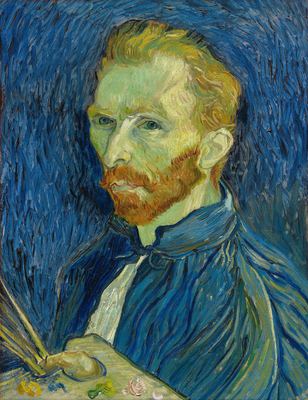
| Self-Portrait | Vincent van Gogh | 1889 | 57.8 × 44.5 |
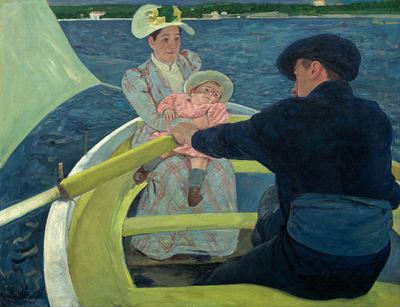
| The Boating Party | Mary Cassatt | 1893–94 | 90 × 117.3 |
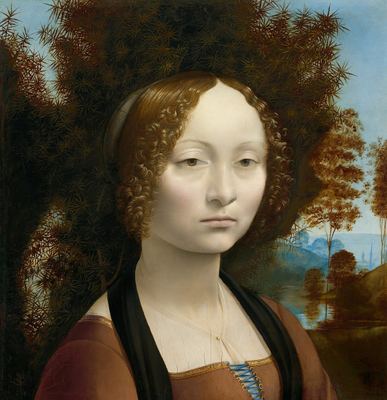
Sixteen, in front of a juniper
 Solve this painting as a puzzle → about 5 minutes on Easy
Ginevra de’ Benci is a small panel, less than 40 centimeters on each side. Leonardo painted it in Florence in the 1470s, while he was in his twenties, and it is the earliest of his portraits of women. The sitter was the daughter of a banking family, said to have been painted at about sixteen, around the time of her marriage. The prickly bush that fills the background is a juniper, ginepro in Italian. Her name is hidden in the picture, and once you know that, the bush looks different. The back of the panel is painted too, with a sprig of juniper encircled by laurel and palm.
When you put it together as a puzzle, you spend longer on that bush than on the face. The star-shaped leaves repeat the same pattern, so sort the pieces by the patches of pale blue sky showing through along the top edge and by the brown that turns redder toward the right.
A generation later in Italy came Raphael’s The Alba Madonna. In a round picture it shows the Virgin seated in a field with the infant Jesus and the young John the Baptist. It takes its name from the Spanish dukes of Alba, whose family owned it for a long time. It later passed to the Russian tsar and hung in the Hermitage, until it crossed the ocean in 1931 when the Soviet government sold off works of art.
Two Vermeers and a Rembrandt
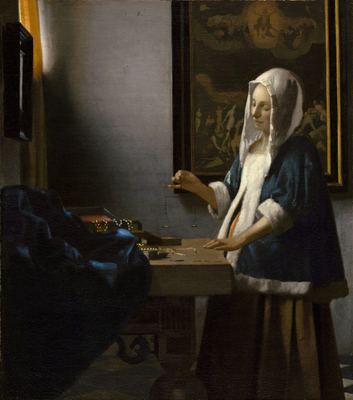
Vermeer left only thirty-some paintings in his lifetime, and two of them are here. In Woman Holding a Balance, the scales she holds are empty. The scene used to be described as a woman weighing pearls or gold, until close examination confirmed that the pans are empty. Because the painting on the wall behind her is a Last Judgment, in which souls are weighed, the picture is often read as a lesson in moderation, set beside the pearls and gold coins on the table. Girl with the Red Hat is painted on a wood panel less than 23 centimeters tall. Standing in front of it, you find it much smaller than you expected, and you lean in for a second look. Where these two fall among his other paintings is shown in eight Vermeer paintings in the order he painted them.
Rembrandt’s Self-Portrait was painted in 1659, when he was fifty-three, after bankruptcy had forced him to sell his house and his collection. Under a beret, his old face is shown without any flattery, and it is one of the best-known of his late self-portraits. The one he painted a year later is at the Met, so if you visit both museums you can compare two faces painted a year apart. Rembrandt’s eight paintings on this site are gathered in eight Rembrandt paintings.
White, a parasol, a watering can
Whistler’s Symphony in White, No. 1: The White Girl is more than two meters tall. A red-haired woman in a white dress stands in front of a white curtain. At the time, a portrait this size was normally reserved for someone famous, so it puzzled the public in London in 1862. The next year it was rejected by the Paris Salon, hung in the Salon des Refusés instead, and caused a stir. As a puzzle it is the hardest of the eleven, because most of the pieces are white. You get through on a single difference: the curtain is yellowish with vertical folds, while the dress is whiter, with gray shadows spreading toward the bottom.
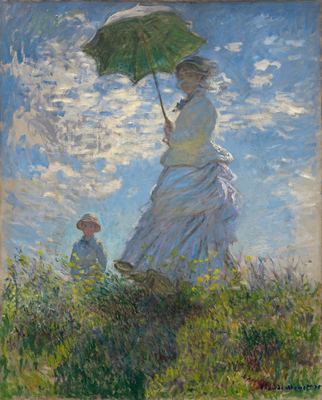
Monet painted Woman with a Parasol - Madame Monet and Her Son in 1875 on a hillside in Argenteuil, looking up at his wife Camille and their son Jean. He painted it quickly in one go, and bare canvas shows through in places across the sky. If you want a painting with wind in it, this is the one. Renoir’s A Girl with a Watering Can shows a child in blue standing on a garden path among flowers. No one knows for sure who the model was; she is thought most likely to have been a neighbor’s child. In Mary Cassatt’s The Boating Party, the high horizon and flat areas of color show a clear debt to Japanese prints. The rower’s navy back covers a large part of the lower half.
Van Gogh in Arles and Saint-Rémy
There are two by Van Gogh. La Mousmé is a portrait of a girl painted in Arles in the summer of 1888; the title is a Japanese word he took from a novel by Pierre Loti. Her striped jacket, polka-dot skirt and sprig of oleander each have their own colors and patterns, so the puzzle divides easily into sections. The Self-Portrait he painted a year later at the asylum in Saint-Rémy shows him holding a palette and brushes. The swirling background and his work jacket are the same blue, so you tell them apart by the direction of the brushstrokes: the background curves around his head, while the jacket runs up and down along its folds.
What to check before you go
The permanent collection is free, but a work you want to see may be out on loan or moved to another gallery. Check the work’s page on the museum’s website to see whether it is currently on view, and you’ll save yourself a wasted trip. All eleven are gathered on the National Gallery of Art page. If the same trip takes you to New York, there’s the Met guide, and if you stop in Chicago, the Art Institute of Chicago guide.
Walking in without a ticket and standing in front of a Leonardo is something that rarely happens at other museums. Count the leaves of that bush one by one in front of the little panel, and you’ll understand why that part took you so long as a puzzle.
Frequently asked questions
Which paintings should I not miss at the National Gallery of Art?
Leonardo da Vinci's Ginevra de' Benci comes first; it is the only painting by Leonardo in the Americas. Vermeer's Woman Holding a Balance and Girl with the Red Hat, Raphael's The Alba Madonna, Monet's Woman with a Parasol, and self-portraits by Rembrandt and Van Gogh are also in the collection.
Does the National Gallery of Art charge admission?
No. The permanent collection is free for everyone. Some special exhibitions may require timed-entry passes, so it's a good idea to check the museum's website before you go.
Is the National Gallery of Art the same as the National Gallery in London?
No, they are different museums. The one in London is the National Gallery; the one in Washington is officially the National Gallery of Art, and it stands on the National Mall in Washington, D.C.