Two Reliefs of Officials Buried Beside the Pyramid of Amenemhat I
Published
Red-skinned men walk in single file, carrying birds, lotus flowers and food. It is a procession bearing offerings for the king. Scenes like this filled the walls of the ruined temple of Amenemhat I, but they were not carved only in the king’s temple. Reliefs of the same kind also survive from the cemetery near the temple where officials were buried. The two pieces below are examples.
| Work | Material | Size | Acquisition |
|---|---|---|---|
| Relief showing procession of offering bearers | Limestone, painted | Height 146.2cm | Rogers Fund, 1909 |
| Relief block from the tomb of Sebeknakht | Limestone, painted | Height 125cm | Rogers Fund, 1909 |
A procession of offering bearers with its paint intact
 Solve this painting as a puzzle → about 5 minutes on Easy
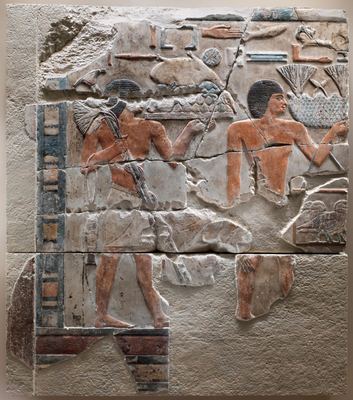
Relief showing procession of offering bearers is the procession described at the start. The walls of pyramid temples were filled with people like these, coming to present offerings to the king. The offering bearers stand for the king’s estates. The birds, lotus flowers and food they carry represent the endless tribute the king would receive after death.
This panel, 1.5 meters tall, is said to have broken into several pieces and been joined back together. Red, blue and black survive here and there, so, as with the lintel from the temple of Amenemhat I, you can faintly imagine how colorful the original temple walls must have been. The figures are drawn with faces in profile and shoulders seen from the front. It is the same rule Egyptian relief followed for a very long time.
As a puzzle, about 100 pieces suits it well. Gather the red-skinned figures and the blue lotus pieces first, and place the hieroglyph pieces at the top while checking often against the preview. The dark lines running along the cracks are also quite useful when fitting pieces into place.
The offering list Sebeknakht left on his tomb wall
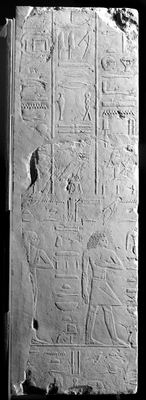
Relief block from the tomb of Sebeknakht is a tall, narrow limestone slab carved in several registers. At the top are hieroglyphs listing offerings, and below, figures standing in profile hold offerings.
Sebeknakht was an official of the 12th Dynasty. The walls of his tomb appear to have been a device for guaranteeing, in images and words, the offerings he would receive after death. Just as the king’s temple walls promised him eternal offerings through text and relief, an official used the same method to look after his own afterlife. You can see more of the sculpture left by people who were not royalty in Egyptian non-royal sculpture.
Where this slab came from is also worth noting. It is thought to come from the officials’ cemetery near the pyramid of Amenemhat I. That means the people who served the king were buried right beside the place where he built his temple. The location of the tombs speaks of a wish to stay close to the king even in death.
The puzzle image is black and white, so apart from the direction of the shadows cast by the carving, there are no clues to rely on. Because the slab is so tall and narrow, the pieces are cut flat as well. Start with the silhouettes of the figures at the bottom, and judge the position of the text at the top using the horizontal lines that divide the registers. 48 pieces is plenty.
Stone carved in the same grammar for king and official
Set the two reliefs side by side and you can see that king and official used the same visual language. Faces in profile and shoulders from the front, a surface divided into registers, a procession presenting offerings. Where these rules came from is the subject of conventions in Egyptian sculpture. If the reliefs from the temple of Amenemhat I were carved for the institution of kingship, these two pieces were carved in the same way for individuals who served that institution. The scale and richness of materials would have differed, but the forms of belief in the afterlife did not depend on rank.
The boat models from the tomb of Meketre were objects for preparing one man’s journey to the afterlife. What these reliefs prepared is a little different: receiving offerings forever, beside the king and together with him. They could not match the king’s temple in the splendor of their stone, but the care they took in preparing for what comes after death was no less.