An Afterlife Fleet in Five Pieces from a Hidden Chamber in Meketre's Tomb
Published
Cooks baking bread under a white awning, boatmen gripping their oars short, a woman carrying a basket on her head. Palm-sized people have been doing the same work for 4,000 years. The Egyptian Art department has several painted wooden boat models, and their museum records all carry the same credit line: “Rogers Fund and Edward S. Harkness Gift, 1920.” They are boats that came out of the tomb of one man, Meketre.
The chamber the tomb robbers never found
Meketre was a high official in Thebes around the 20th century B.C. In 1920, an excavation team from The Metropolitan Museum of Art found a hidden chamber inside his tomb, and in it were twenty-four wooden models. Boats and a garden, a bakery, a slaughterhouse, even a weaving workshop: the entire household the dead man would need in the afterlife, shrunk down and packed away.
The key is that the chamber was hidden. Because tomb robbers never found it, colors from 4,000 years ago survived as they were. The five pieces you can see here are some of those twenty-four.
| Work | Length | What it carries |
|---|---|---|
| Estate Figure | Height 112cm | A woman holding a basket and a duck |
| Model Paddling Boat | 132.5cm | A boat for marshes and riverbanks |
| Kitchen Tender being Rowed | 147cm | A supply boat preparing food |
| Travelling Boat being Rowed (first) | 117cm | Meketre’s journey after death |
| Travelling Boat being Rowed (second) | 128–175cm | The same journey, a different cabin pattern |
A woman who carries food forever
 Solve this painting as a puzzle → about 5 minutes on Easy
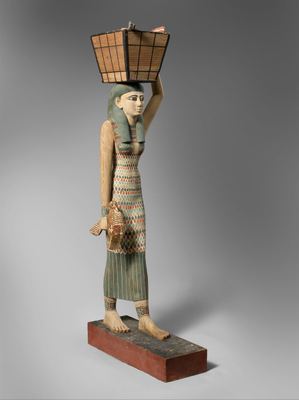
Of the five, only Estate Figure is not a boat. It shows a woman walking with a basket on her head and a duck in her hand. Figures like this represent “offering bearers” who carry grain, meat, and fowl from the dead person’s estates to the tomb. It was believed that placing such a figure in the tomb would let the dead receive food endlessly in the afterlife.
At 112 centimeters tall, it stands out among the five in both size and craftsmanship. After 4,000 years, the green and red vertical pattern of her dress is still vivid.
Four boats with different jobs
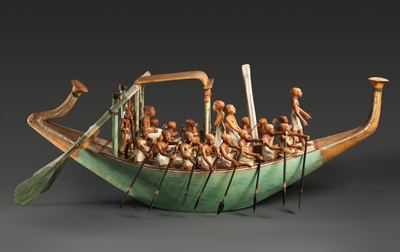
In Model Paddling Boat, more than ten boatmen paddle above a green hull. Boats paddled with short strokes were used in the shallows of the Nile and in marshes. The green hull appears to imitate a papyrus boat, and such boats are said to have been used for pilgrimages to temples or for funeral processions.
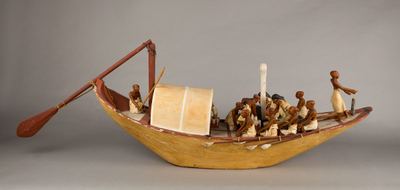
On Kitchen Tender being Rowed, cooks under a white awning bake bread, brew beer, and prepare meat. When Egyptian nobles traveled on the Nile, a kitchen boat preparing their food followed behind the boat they rode in. The idea was probably that Meketre should not have to worry about his meals on his journey to the afterlife either.
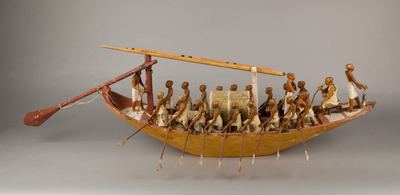
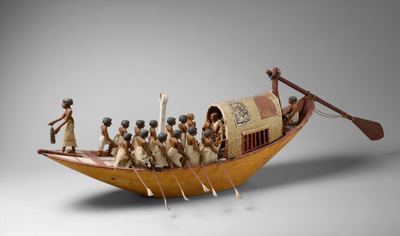
The two Travelling Boats are the boats Meketre himself rides in. Both have boatmen rowing, a cabin in the middle, and a lowered mast. Rowing with the sail down is said to show the boat heading downstream, that is, north, with the current, while a boat with its sail raised shows it going upstream, south, against the current. A round trip up and down the river was placed in one tomb. Seen side by side, the two boats differ slightly in the pattern of the cabin cloth and the positions of the boatmen.
Put the five together and a single scene comes to mind. The offering bearer carries food, the kitchen boat cooks, and the two travelling boats go up and down the river. A small fleet takes shape. That an entire, finely made miniature world was buried for one dead man shows how vividly the ancient Egyptians imagined the afterlife.
Start with one row of boatmen
All five keep their bright colors clearly, so they are easy to sort by color. There are distinct large color areas, like the yellow and green hulls, the white awnings, the reddish-brown skin, and the white kilts, so if you set those boundaries first, the picture divides into a few zones. In the boat models, the boatmen sit in two repeating rows, so once you assemble one row, you can guess where the other goes. The prow rising like a bundle of papyrus and the stern with its large steering oar have distinctive shapes and make reliable reference points. The photo backgrounds are mostly a single color, so fill them in last, after all the people and boats are done. Normal (about 48 pieces) or Hard (about 100) suits these, and for tall pieces like the offering bearer, it is easiest to work from top to bottom.
Another example of several pieces found as a set, though not from one tomb, is the four wooden statuettes of Merer. Other conventions that Egyptian sculpture follows are in The conventions of Egyptian statues, and general tips for puzzles from this department are in the Egyptian art puzzle guide.
Boats that are not toys
These boats were not made as playthings. The Egyptians believed that what was made as a picture or a model would become real in the afterlife. As you fit the five together, one official’s wishes come through to your fingertips: to keep traveling up and down the river after death, to have a cook follow along for every meal, to receive the produce of his estates forever. Thanks to the boatmen who waited oars in hand inside a hidden chamber for 4,000 years, those wishes have survived intact, at least in their colors.