Hungarian Shepherds' Winter Clothes, Part 2: Four More From the Same Expedition
Published
Some garments have the phrase “Museum Expedition 1920·1921·1922” at the end of their collection records. It means they came from the collecting expeditions the Brooklyn Museum sent to Eastern Europe between 1920 and 1922. Hungarian shepherds’ winter clothes covered six of those garments, but four more from the same expedition remained. This post is, so to speak, season two.
| Work | Material | Date |
|---|---|---|
| Jacket | Leather, wool, metal, glass, silk | Late 19th century |
| Blouse | Cotton | Late 19th century |
| Mantle | Wool, leather, cotton | 1840–70 |
| Blouse | Cotton | Late 19th century |
The more buttons, the richer
 Solve this painting as a puzzle → about 5 minutes on Easy
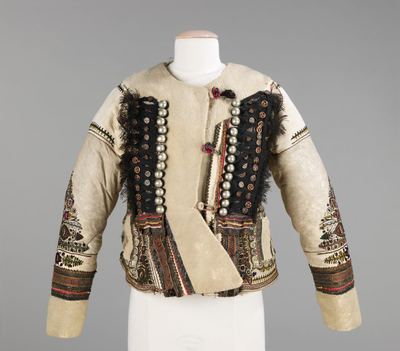
The Jacket has a cream leather ground. Bands of black curly fleece run down both sides of the front opening with rows of round metal buttons, and the cuffs and shoulders are embroidered in red and green. A sheepskin jacket was a winter essential in the Eastern European countryside, and those worn at festivals were decorated like this with fleece, buttons, and embroidery. The metal buttons were decoration rather than fasteners. The more of them, the wealthier the wearer.
In the puzzle, the black fleece bands and the rows of metal buttons stand out most. Assemble those first, set both sides with the embroidery at the cuffs, and then fill in the cream leather. 48 pieces is right.
A blouse made known in Western Europe by Matisse’s paintings
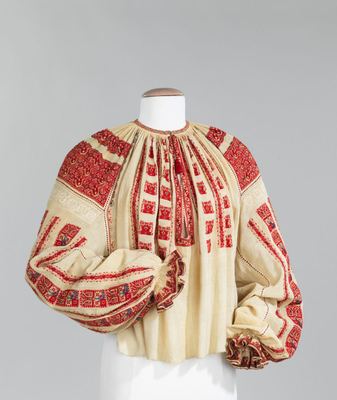
The Blouse is gathered narrow at the neckline, with bands of red geometric embroidery around the shoulders and upper sleeves. Red embroidery also runs vertically down the front. Blouses like this are a form widely known as the Romanian “ie,” and neighboring countries have similar garments. The place that receives the most care is the embroidered band at the shoulder, and each village had its set pattern. A large part of why this form became famous as far as Western Europe was that Henri Matisse painted several pictures of women wearing it.
The white cotton and red embroidery divide by color, so start with the embroidered bands at the shoulders and the vertical embroidery on the front. Between 48 and 100 pieces is right.
A mantle on which tailors competed in skill
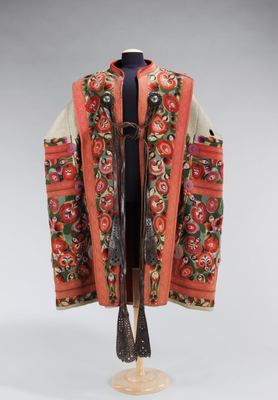
On the cream wool ground of the Mantle, embroidery of red roses and green leaves runs broadly along the front opening, the sleeves, and the hem. Long ornaments cut from black leather hang down the front. The Hungarian shepherd’s coat, the szűr, was worn draped over the shoulders without putting the arms through the sleeves, and the sleeve ends were sometimes sewn shut to serve as pockets. Rose embroidery this broad is characteristic of the mid-19th-century “cifraszűr” (decorated szűr). It is a garment from the time when tailors competed in embroidery skill. It looks similar to the mantle in the previous post, but the density of the embroidery differs, so it is interesting to set them side by side.
The red rose embroidery follows the outline of the garment, which makes the frame easy to set. Assemble the black leather ornaments in front and the neckline first, run the embroidered bands around the sleeves and front opening, and then fill in the cream pieces. 100 pieces is right.
One more garment hanging in the back of the photo
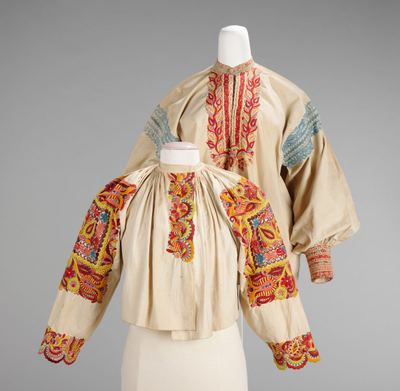
The Blouse is a cream cotton blouse dressed on the mannequin in front. Floral patterns are embroidered in red, yellow, and blue thread on the upper sleeves, the wrists, and the center of the front. Look closely at the photograph and another blouse, with red embroidery on its sleeves, hangs in the back. This entry refers only to the front blouse; the one behind is a separately catalogued object. Concentrating embroidery on the sleeves and front is a common form of women’s blouses in Romania, Bulgaria, and Ukraine, and people could tell from the colors and patterns of the embroidery which village a garment came from.
The red embroidery of the front blouse and the blurry pieces behind it separate by brightness. Assemble the embroidery on the front sleeves and front panel first, set the center with the gathers at the neckline, and then fill in the background. 100 pieces is right.
One collecting trip
Add these four to the six in the previous post and you can see how wide a range of clothing one museum’s expedition gathered over a few years in the early 1920s. There is the Hungarian szűr, the Romanian ie, and vests and jackets from somewhere in between. Taken one at a time they are scattered artifacts, but a single phrase in the collection records ties them all together.
Embroidery from the same period and region also appears in A tour of Eastern European embroidery and Layered European women’s folk dress. The names of the people who made the garments still remain unknown. Even so, because someone back then packed their bags and went around Eastern European villages, the roses and buttons they stitched are gathered in one place today.