Never Made Saints, but Remembered by Siena: Giovanni di Paolo's Two Blesseds
Published
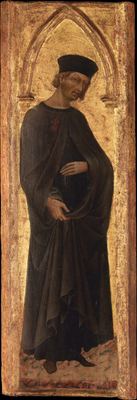
Inside a gold arch stands a gaunt man in a black hat and black cloak. In the panel beside him is a man in a white habit and black cloak, holding a red book. Neither is a saint officially recognized by the Church. Even so, the people of their hometown, Siena, did not forget them. They are Andrea Gallerani and Ambrogio Sansedoni, each called a Blessed (beato). If Bernardino in three portraits of Saint Bernardino of Siena is a recognized saint, these two men received their hometown’s veneration one step below that.
| Work | Figure | Dates | Size |
|---|---|---|---|
| The Blessed Andrea Gallerani | Sienese nobleman, founder of a hospital | Died 1251 | 51.4 × 17.8 cm |
| The Blessed Ambrogio Sansedoni | Dominican friar | 1220–1286 | 52.4 × 17.8 cm |
Both panels were painted by Giovanni di Paolo in tempera and gold leaf on wood. They are nearly the same size and exactly the same width, 17.8 cm, which suggests they were originally a pair hung side by side on the left and right of a single altarpiece.
The difference between a saint and a Blessed
A saint is a person the Church has recognized through an official procedure. A Blessed is one step lower. It is a person who has not gone through, or has not yet completed, the formal canonization process, and whom a particular region or community venerates on its own. Think of it roughly as the difference between a great figure known to the whole country and a local figure honored with special devotion only in their hometown.
The nobleman who founded a hospital
 Solve this painting as a puzzle → about 5 minutes on Easy
The subject of The Blessed Andrea Gallerani was a 13th-century Sienese nobleman. He was venerated as a Blessed for founding a hospital and caring for the poor. That he was a nobleman who stood beside the poor won the hearts of the people of his hometown.
Giovanni di Paolo is counted among the most distinctive painters of 15th-century Siena. Long, thin bodies and sharp faces are characteristic of his figures, and that style shows clearly in Gallerani, with his gaunt face and black clothes.
The friar of preaching and diplomacy
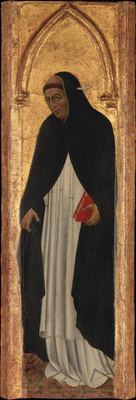
The Blessed Ambrogio Sansedoni shows a 13th-century Dominican friar of Siena. He made his name through preaching and diplomacy and was venerated as a Blessed in his hometown.
The white habit and black cloak are the prescribed dress of the Dominican order. The tonsured head, the lowered gaze, and the red book in his hand are iconography commonly used for painting a learned friar. If Gallerani earned respect through charity in the secular world, Sansedoni left his name within the Church through words and negotiation.
Two men painted as a pair
That the two panels are a pair is clearly stated in the museum’s descriptions as well. The description for Gallerani says this panel pairs with The Blessed Ambrogio Sansedoni in the same museum and was part of an altarpiece honoring Siena’s local saints. The one for Sansedoni notes that, as a pair with Gallerani, it shows how much Siena cherished its own saints.
A charitable man of noble birth and a diplomat who came from the friars. Two men whose social standing and paths in life were different were painted side by side on the same altarpiece. It means Siena had more than one way of honoring its own people.
Why they never became saints
Why the two men never became official saints cannot be known from the materials here alone. Canonization was a long process and was also swayed by politics, so it is likely that several circumstances overlapped, rather than that they lacked the qualifications. The people of Siena did not wait for official recognition. Painting them into an altarpiece was itself one way of showing local veneration.
Start with the boundary between black clothes and gold
The two panels have similar compositions: a gold ground, a narrow, tall picture, a figure in black. Assemble the pieces along the boundary where the black clothes meet the gold first, and the figure’s silhouette stands up before anything else. Then use the objects to tell the two men apart. With Gallerani, the empty hand held forward stands out; with Sansedoni, the red book in his hand. If you set the structural lines with the pointed arch at the top and the patterned floor at the bottom, the whole picture falls into order.
As described in the gold panel painting puzzle guide, fill in the gold after finishing the figure, working outward from around the halo. The paintings are narrow and tall, so the grid also comes out narrow. 24 or 48 pieces is about right.
People their hometown remembers
Though they did not become saints, the two men have endured for centuries on an altarpiece of the city where they were born and raised. Even in the days, as discussed in dismembered altarpiece panels, when large altarpieces were sold off as separate pieces, this pair stayed together and was not scattered. It seems that sometimes a city’s steady affection lasts longer than having your name on an official list.