What Is Ukiyo-e? Its Meaning, Features and Influence on the Impressionists and Van Gogh
Published
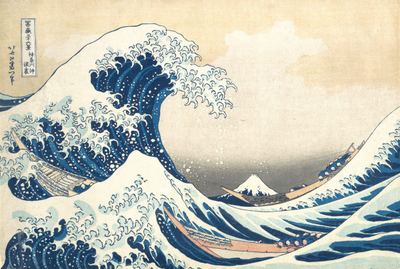
Ukiyo-e (浮世絵) are pictures that were popular in Japan during the Edo period, from the late 17th century to the 19th century. The name means “pictures of the floating world,” that is, pictures of the pleasures of the fleeting present. Most were woodblock prints, so the same picture could be printed many times and sold cheaply, and the ordinary people of Edo (today’s Tokyo) bought them and enjoyed them much as we enjoy posters or pin-up photos today. Hokusai’s wave is the most famous ukiyo-e of all.
Four people make one print
An ukiyo-e print was not made by the artist alone. The work was split four ways.
- Publisher: decided what to print, commissioned the artist, and sold the finished prints.
- Artist: drew the design in ink on thin paper.
- Carver: pasted the design onto a wooden block and cut away the wood, leaving the lines. A separate block was carved for each color.
- Printer: brushed paint onto a block, laid paper over it and rubbed by hand to print. The color blocks were printed one over another to complete the picture.
At first the prints were made in black ink alone and colored by hand. From around 1765, beginning with the prints of Suzuki Harunobu, multicolor woodblock printing with several color blocks took hold, and because the results were as gorgeous as brocade, they were called nishiki-e (錦絵, “brocade pictures”). The Metropolitan Museum of Art’s records also list the Hokusai and Hiroshige prints as “nishiki-e.”
What they showed
They showed what the people of Edo wanted to see, because the prints had to sell.
- Pictures of beautiful women: women in fashionable clothes and hairstyles. Kitagawa Utamaro is the leading example.
- Kabuki actor prints: the faces of popular actors and scenes from the stage. Tōshūsai Sharaku’s exaggerated faces are famous.
- Landscapes and famous places: these grew popular in the 19th century as travel increased. Katsushika Hokusai’s Thirty-six Views of Mount Fuji and Utagawa Hiroshige’s The Fifty-three Stations of the Tōkaidō and One Hundred Famous Views of Edo are the masterpieces of this kind.
- Flowers and birds: many prints also showed the flowers and birds of the seasons.
Five features of ukiyo-e
- Crisp outlines. The carver kept the artist’s lines exactly with the knife, so every shape has a black outline.
- Flat areas of color. Each color is printed from its own block, so there is no in-between zone where colors mix. The picture is divided into areas of color rather than built up into three dimensions with shadow.
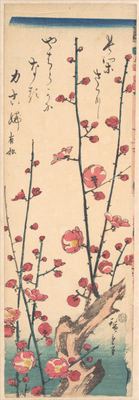
- Bold compositions. Hokusai’s Under the Wave off Kanagawa sets a tiny Mount Fuji beyond a gigantic wave. In One Hundred Famous Views of Edo, Hiroshige set a thick plum branch or a bridge post large, right at the front of the picture, and drew the people in the distance very small.
- Series. A single theme was issued as a series of dozens of sheets. Thirty-six Views of Mount Fuji shows, sheet after sheet, where and how Mount Fuji can be seen.
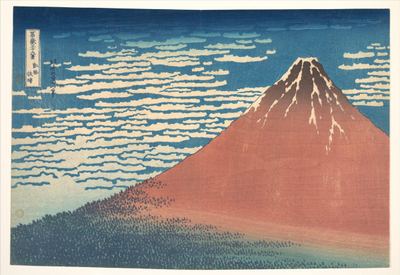
- New pigments. The deep blue of Under the Wave off Kanagawa was possible thanks to Prussian blue, which had arrived from Europe at the time. South Wind, Clear Sky (Red Fuji), from the same series, paints the mountain flushed red by the dawn light with three colors and a single triangle.
Prints that crossed to Europe: Japonisme
When Japan opened its ports in the 1850s, Japanese goods poured into Europe, and Japanese art was also shown at the 1867 Paris Exposition Universelle. Painters in Paris fell for prints that were utterly unlike Western painting, which builds space with perspective and shading. This craze is called Japonisme (a taste for things Japanese). Flat areas of color without shadow, objects cut off at the edge of the picture, and views from above seeped into the work of the Impressionists and the generation after them.
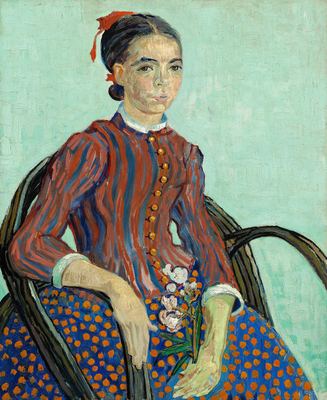
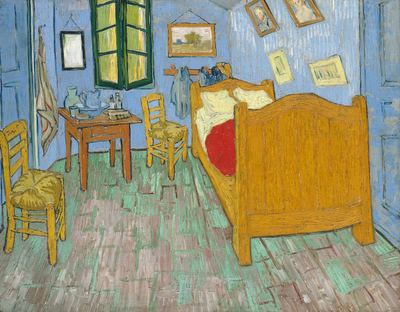
- Vincent van Gogh collected hundreds of Japanese prints, and in Paris in 1887 he copied in oil, faithfully, Hiroshige’s print of the Kameido plum garden from One Hundred Famous Views of Edo. La Mousmé, painted in Arles in 1888, takes its title from a Japanese word borrowed from a Pierre Loti novel set in Japan, and the strong color contrast of the striped jacket and the polka-dot skirt shows the influence of the prints. Of The Bedroom, he wrote to his brother Theo that he had left out the shadows and painted it in flat colors like a Japanese print. Van Gogh’s story continues in six Van Gogh paintings and what is Post-Impressionism.
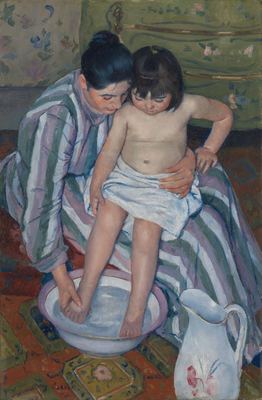
- Mary Cassatt took up high viewpoints and flat patterns after seeing an exhibition of Japanese prints in Paris in 1890. The Child’s Bath (1893) looks down from above, with a striped dress, a flowered rug and patterned wallpaper layered together.
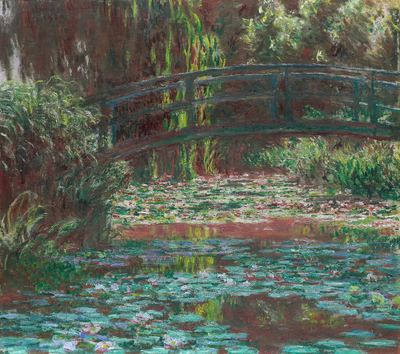
- Claude Monet built a round wooden bridge in the Japanese style over the pond in his garden at Giverny, and painted that bridge in Water Lily Pond (1900).
Seeing ukiyo-e through puzzles
When you fit ukiyo-e together as a puzzle, their features are right there in your hands.
- Follow the outlines. Every shape has a black line, so join pieces whose lines continue. Places where a line bends, like the tips of the wave’s foam or the joints of a plum branch, make good reference points.
- Sort by color block. Colors don’t mix, so pieces are easy to sort by color. For Red Fuji, first split them into three piles: the blue of the sky, the reddish brown of the mountain and the green of the foothills.
- Find the text panels. Ukiyo-e have a title cartouche or the artist’s signature inside the picture. In Under the Wave off Kanagawa, the title cartouche and signature at upper left tell you where pieces go.
- Leave wide single-color areas for last. Where one color spreads wide, like the sky, tell top from bottom by differences in depth of color.
If it’s your first time, start with 24 to 48 pieces. Detailed tips for solving the three prints are collected separately in three prints by Hokusai and Hiroshige. How a composition that makes near things absurdly large, as Hiroshige did, differs from Western perspective continues in what is perspective.
Frequently asked questions
What does ukiyo-e mean?
Written 浮世絵, it means "pictures of the floating world." The prints showed the pleasures of the fleeting present that the people of Edo loved: fashionable beauties, kabuki actors and famous scenic spots.
Who made ukiyo-e?
Because most ukiyo-e are woodblock prints, no single person made them. A publisher planned and sold the prints, an artist drew the design, a carver cut a block for each color, and a printer printed the blocks one over another.
Who are the best-known ukiyo-e artists?
For landscapes, Katsushika Hokusai of Thirty-six Views of Mount Fuji and Utagawa Hiroshige of One Hundred Famous Views of Edo; for pictures of beautiful women, Kitagawa Utamaro; and for kabuki actor prints, Tōshūsai Sharaku.
How did ukiyo-e influence Western art?
In the late 19th century Japanese prints poured into Europe and set off the craze called Japonisme. Van Gogh copied Hiroshige's plum garden print in oil, and Mary Cassatt took up high viewpoints and flat patterns after seeing an exhibition of Japanese prints in Paris in 1890.