What Is Realism in Art? Meaning, Key Features, Millet and the Barbizon School
Published
Realism is an art movement that began in France in the mid-19th century. Instead of gods from myth or heroes from history, its painters showed the ordinary people, work and countryside they had seen for themselves, without prettifying them. It seems natural now, but at the time, simply painting farmers or laborers on a large canvas was a provocation.
Why it appeared
Art in the first half of the 19th century ran along two paths: Neoclassicism, which took the ancient world as its model, and Romanticism, which put feeling and imagination first. The two were different, but they agreed that a painting needed a “special story.” At the Salon, the official exhibition, paintings of myth and history ranked highest.
The Realist painters rejected that hierarchy. A painter, they said, should paint only their own time and what they had seen with their own eyes. How this differs from Romanticism is covered separately in what Romanticism in art is.
Four features of Realism
- It paints the here and now. Not imagined scenes, but the people and places of the painter’s own time.
- Ordinary people are the main characters. Farmers, fishermen and villagers stood where the heroes of myth used to stand.
- Nothing is prettified. The hardship of work, rough hands and muddy clothes were left as they were, not improved into something beautiful.
- Landscape as it is, too. Instead of idealized ancient landscapes, painters went out and painted their local woods, fields and villages from life.
Courbet: the painter who put up the name
At the center of Realism is Gustave Courbet (1819–1877). He made his name with A Burial at Ornans, a funeral in his home village painted on a canvas more than six meters wide. When some of the works he submitted to the 1855 Paris World’s Fair were not accepted, he built his own exhibition hall near the fairgrounds and hung up the name “Realism.” That did a great deal to make the word stick as the name of the movement. Courbet’s paintings are not on this site, but you can solve puzzles of works by painters of the same time who shared the same ideas.
Millet and the Barbizon School
On the edge of the Forest of Fontainebleau, south of Paris, lies a small village called Barbizon. In the mid-19th century, painters gathered in and around it to paint the forest, the fields and rural life. They are called the Barbizon School. Théodore Rousseau, Narcisse Diaz de la Peña, Charles-François Daubigny and Jean-François Millet are the best-known.
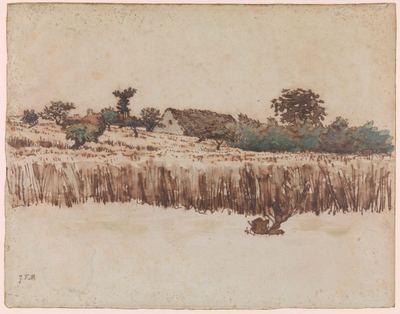
Jean-François Millet (1814–1875) was famous for his paintings of peasants. The Gleaners and The Angelus at the Musée d’Orsay are his best-known works. On this site, Hamlet in a Wheat Field, Vichy (1867) is a summer field Millet drew quickly in pen and watercolor in the spa town of Vichy, where he stayed while his wife took a cure. Rather than draw every ear of wheat, he repeated short lines in the same direction to build up the texture of the field.
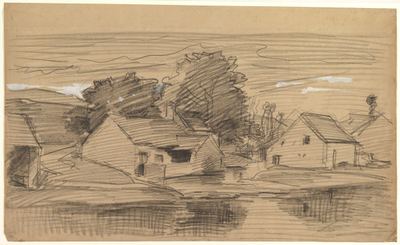
Charles-François Daubigny (1817–1878) drew The Hamlet of Optevoz (about 1852), a charcoal drawing of a country house by a pond and a large tree. Daubigny is also known for later fitting out a boat as a studio and painting as he traveled along the river. Drawings by both artists can be seen together in Millet, Daubigny and Decamps: village sketches.
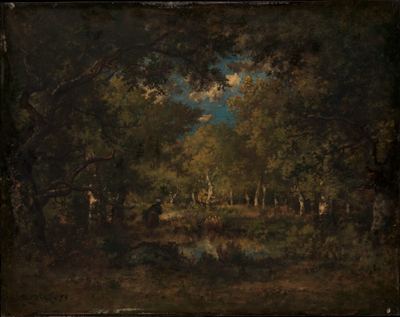
Narcisse Diaz de la Peña painted deep inside the forest, where little light gets in. The Forest of Fontainebleau (1874) looks out from inside the dark woods toward a bright sky. There is more in Diaz’s three Fontainebleau forest paintings.
The Barbizon painters completed their pictures from studies made by going out into the forest and painting what they saw. This habit of painting from life outdoors passed on to the next generation, the Impressionists. That story is in what Impressionism is.
Across the sea: Winslow Homer
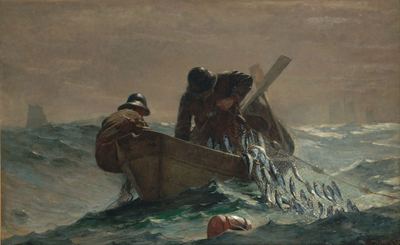
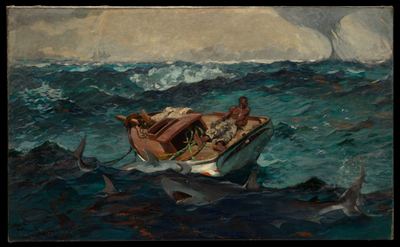
The American Winslow Homer (1836–1910) is also counted as a Realist. The Herring Net (1885) shows two fishermen in a small boat on a rough sea hauling in a net full of silver herring. In The Gulf Stream (1899), a sailor lies on a boat whose mast has snapped while sharks circle it. Homer painted people facing the sea without glorifying them.
An older precedent
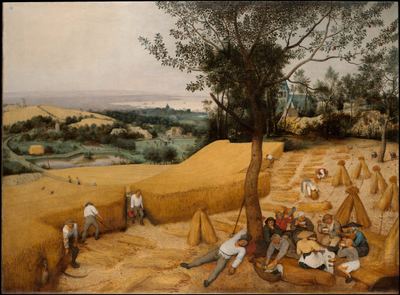
Realism as a movement belongs to the 19th century, but paintings that showed the work of ordinary people as it was existed before that. Pieter Bruegel’s The Harvesters (1565) shows farmers who have stopped cutting wheat to rest and eat in the shade of a tree. It is a painting 300 years older, but set side by side, it makes clear what the Realist painters were trying to paint.
Seeing Realism through puzzles
- Drawings by the direction of the lines. In Hamlet in a Wheat Field, Vichy, the vertical lines of the wheat field take up half the picture. Fit the horizontal band with the houses and trees first, then split the wheat field into the darker lines at the top and the paler ones at the bottom. In The Hamlet of Optevoz, the sky is drawn in horizontal hatching and the pond’s reflections in vertical hatching, so direction alone tells top from bottom.
- Dark forests from the bright pieces. The Forest of Fontainebleau is one of the hardest puzzles on the site. Pick out the blue sky, the bright tree trunks and the figure in the middle first to anchor the center, then close in on the dark pieces from the edges toward the middle.
- Seas from the people and boats. In both Homer paintings, fit the boat and the people first, then split the water into bright foam and dark water and join them.
If you are new to this, start with a drawing at 24 to 48 pieces: with fewer colors, the lines are actually easier to see. As you study the pieces, what the artist was looking at starts to come into view.
Frequently asked questions
What does Realism mean in art?
It is an art movement that began in France in the mid-19th century. Instead of heroes from myth or history, its painters showed the ordinary people, work and countryside they had seen for themselves, without prettifying them. Gustave Courbet is its leading painter.
What is the Barbizon School?
It is the name for the painters who gathered in and around the village of Barbizon, on the edge of the Forest of Fontainebleau south of Paris, to paint landscapes and rural life. They include Jean-François Millet, Théodore Rousseau, Narcisse Diaz de la Peña and Charles-François Daubigny.
How is Realism related to Impressionism?
Realism made the ordinary life of the here and now a subject for painting, and the Barbizon painters spread the habit of painting directly from what they saw outdoors. The Impressionists inherited both and went on to catch the light and color of the moment.