What Is Romanticism in Art? How It Differs from Neoclassicism, with Delacroix, Goya and Turner
Published
Romanticism is an art movement that ran in Europe from the late 18th century into the first half of the 19th. It put individual feeling and imagination ahead of reason and order, and it was drawn to forces of nature that overwhelm people, such as storms and rugged mountains. Scenes from literature, stories of faraway lands, dreams and nightmares became subjects for painting. The quickest way to understand Romanticism is to set it beside Neoclassicism, the style that came right before it.
First, Neoclassicism: line and restraint
Neoclassicism was the art of the late 18th century that took ancient Greece and Rome as its model. Outlines are crisp, surfaces are polished smooth so no brushstrokes show, and figures are arranged neatly as if on a stage. Its painters believed a picture should teach.
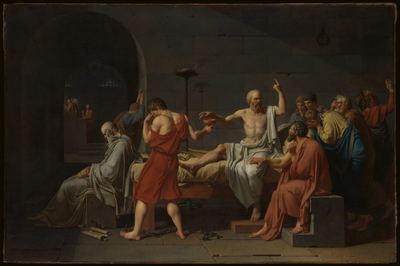
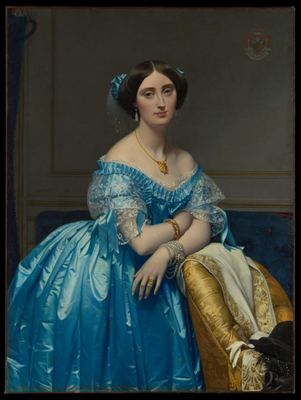
Jacques-Louis David’s The Death of Socrates (1787) is the textbook example. Shown at the Paris Salon two years before the French Revolution, it has Socrates reaching for the cup of poison while raising his other hand to the sky, still talking. His students collapse in tears, but the philosopher does not waver. David’s student Jean-Auguste-Dominique Ingres kept this tradition alive into the mid-19th century. His late portrait Princesse de Broglie (1851–53) renders a blue satin dress and pearls without a single visible brushstroke.
Four features of Romanticism
- Feeling comes first. Rather than calm heroes, Romantic painters showed people who are startled, afraid or grieving.
- Color and brushwork move. They did not smooth their outlines away but left the marks of the brush, so masses of color and movement catch the eye before form does.
- Nature is vast and frightening. In front of storms, rough seas and endless mountain ranges, people are painted small.
- Stories from literature and far away. Instead of ancient Rome, the subjects were Shakespeare and contemporary novels, and distant lands such as America and North Africa.
In Paris at the time, people framed it as Ingres’s line against Delacroix’s color. Opposite kinds of painting were being made in the same city at the same time.
Main painters and works
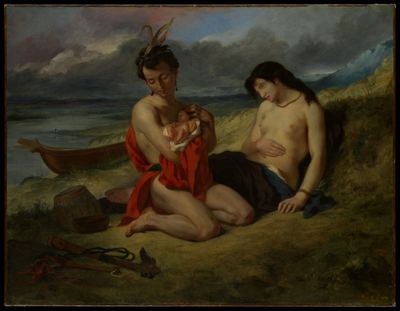
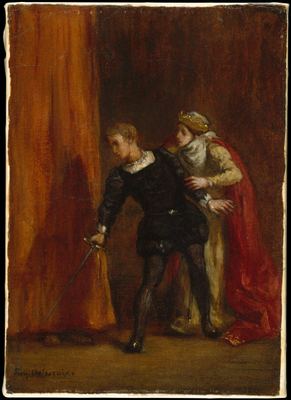
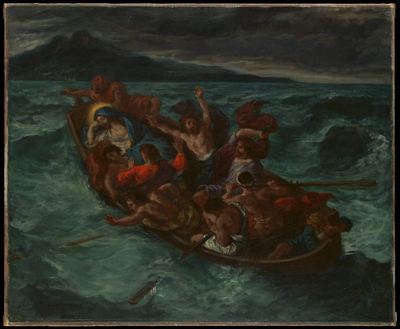
Eugène Delacroix (1798–1863) is the center of French Romanticism. He is best known for Liberty Leading the People (1830). The Natchez takes a scene from a novel by Chateaubriand; he began it in 1823 and only finished it in 1835. Hamlet and His Mother (1849) is a small oil by a painter who returned to Shakespeare all his life, and in Christ Asleep during the Tempest (about 1853) the green waves reach you through color and force before form. The five paintings are gathered in Delacroix’s five scattered paintings.
Francisco de Goya (1746–1828) is counted as a forerunner of Romanticism. A court painter in Spain, he etched superstition, hypocrisy and nightmarish scenes into the 80 plates of his 1799 print series Los Caprichos. The title of plate 43, “The sleep of reason produces monsters,” became a phrase that stands for the era. There is more in the story of Los Caprichos.
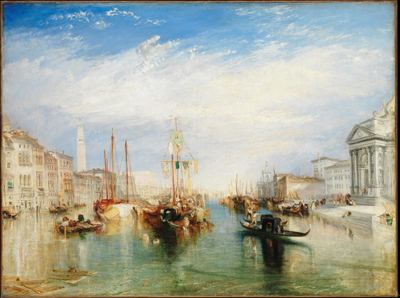
J. M. W. Turner (1775–1851) was a British landscape painter. In Venice, from the Porch of Madonna della Salute (about 1835), water, sky and buildings melt into the same light. His landscapes, which painted light and atmosphere rather than form, are often said to have foreshadowed the Impressionists.
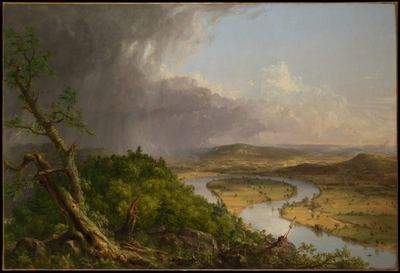
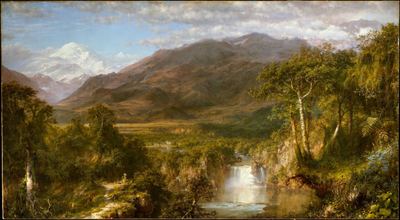
American landscape painters belonged to the same current. Thomas Cole’s The Oxbow (1836) puts rugged mountains with a passing storm and a peaceful river bend in sunlight into a single picture. Heart of the Andes (1859) by Cole’s student Frederic Edwin Church is a three-meter panorama that runs from snow-capped peaks to tropical forest, and it was exhibited in New York to visitors who paid admission. You can follow on in six American paintings.
What came next: Realism
By the mid-19th century, painters appeared who wanted to paint the ordinary life in front of them instead of imagined, dramatic scenes. That current, which grew out of a reaction against Romanticism, is covered in what Realism in art is.
Seeing Romanticism through puzzles
Your hands work differently on the two styles when you solve them as puzzles.
- Neoclassicism by form. In The Death of Socrates, each of the twelve figures wears a different color, so outlines and clothing colors alone put pieces in place. Start with Socrates in white at the center and the man in red.
- Romanticism by masses of color and the direction of the brush. In Christ Asleep during the Tempest, more than half the pieces are sea. Finish the middle band with the boat and figures first, then split the sea into pieces with white foam and pieces without, and join them along the grain of the waves.
- Turner by brightness. In the Venice picture, the water and sky are similar in color. Pick out the pieces that still hold a shape, such as buildings and boats, first, then work outward from the bright center to the darker edges.
If you are new to this, solve a crisply drawn Neoclassical painting at 48 pieces, then try a Delacroix at the same piece count. Your hands will feel the difference between the two before your eyes do.
Frequently asked questions
What does Romanticism mean in art?
It is an art movement that ran in Europe from the late 18th century into the first half of the 19th. It put individual feeling, imagination and the overwhelming power of nature ahead of reason and order, painting dramatic subjects such as scenes from literature, faraway lands and storms with moving brushwork and strong color.
How are Neoclassicism and Romanticism different?
Neoclassicism took ancient Greece and Rome as its model and tried to teach a lesson through crisp outlines, smooth surfaces and restrained compositions. Romanticism conveyed feeling through color and the movement of the brush rather than outline. In Paris at the time, people framed it as Ingres's line against Delacroix's color.
Who are the main Romantic painters?
Eugène Delacroix in France, Francisco de Goya in Spain and J. M. W. Turner in Britain are the leading examples. In America, Thomas Cole and his student Frederic Edwin Church carried the same current into landscapes of nature's grandeur.