Grief Carved in Wood Grain, Without Paint: A South German Virgin
Published
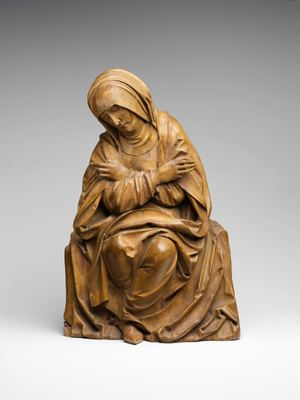
A woman with her head covering pulled low crosses both arms in front of her chest and bows her head. Her robe falls below the knees in heavy folds, her eyes are lowered, and her mouth is closed. Sculptures in the Medieval Art department are mostly gilded or painted, but this Mourning Virgin, made in South Germany in the early 16th century, has not a single drop of paint. The grain and color of the wood show just as they are.
 Solve this painting as a puzzle → about 5 minutes on Easy
It is a small sculpture, 33 centimeters tall. According to the museum record, the material is limewood (linden), and it entered the museum through the Rogers Fund in 1909. The culture is recorded only as “South German”; which city or which workshop it came from has not survived.
It once stood beneath the Cross
Today it stands alone, but it was not alone from the start. It appears to be a sculpture that stood beside Christ on the Cross. Placing Mary and John as a pair beneath the Cross was a long-standing custom of medieval altars.
So this Virgin would have formed a single scene with Christ on the Cross and the apostle John, who would have stood opposite her. The Cross and John are gone, and only the mourning Virgin remains. Like the panels in the Robert Lehman Collection, scattered from large altarpieces, this sculpture too was once part of a set and became separated on its own.
Unpainted wood
Almost all medieval sculpture was painted. It was customary to cover saints’ robes in brilliant colors and their halos in gold leaf. This sculpture does not follow that custom. Limewood has a fine grain, is soft, and does not split easily, so South German sculptors of the early 16th century favored it. In this period there were many works, like those of Riemenschneider, that were left unpainted and used the wood itself as the finish.
Tilman Riemenschneider was a leading South German sculptor of the 15th and 16th centuries, renowned for monochrome sculpture that keeps the wood grain visible. This is not to say that this Virgin came from Riemenschneider’s hand. But it shares an idea that had spread through the same period and region: that leaving a work unpainted can also be a form of completion.
When color is gone, the eye goes elsewhere: how deep the folds of the robe are, which way the grain runs, how shadows fall on the face. The skill of carving the folds large and angular also came from that tradition. Instead of color, the sculptor tried to convey grief through the depth and angle of the knife.
A mother who does not weep
What strikes hardest in this sculpture is less the facial expression than the posture of the body. Both arms crossed in front of the chest, the head deeply bowed, the eyes lowered, the mouth closed. Without struggling or tears, she quietly endures.
In carving a mother watching her son’s death beneath the Cross, the sculptor chose silence over wailing. Perhaps it feels that way all the more because there is no paint. With no showy color to catch the eye, only the brown of the wood and the deeply cut shadows remain, and that is what holds a viewer for a long time.
Gather the shadows first
Since the sculpture has almost no color, the “sorting by density” approach I described for Degas and Lautrec’s drawings works well. If you start by gathering the deep shadows made by the heavy, angular folds, that is, the darkest pieces, the overall flow of the folds falls into place. The bowed face and the hands crossed in front of the chest have clear shapes, which makes them good for fixing in place. There is no color, but the tones run through many steps from light brown to dark brown, so sorting by brightness in advance reduces confusion. The background is a single color, so finish the figure’s outline first and fill the background in last. The form is tall, so working from top to bottom is easiest, and Easy (about 24 pieces) or Normal (about 48) suits it.
A silence that has lasted more than 500 years
There is no gold leaf, and no story of many intertwined figures. There is only one person with her head bowed. If you want to see more small medieval sculpture, Small treasures of the Middle Ages and A thousand years collected by one man have palm-sized carvings in ivory and boxwood. You might also compare it with Sienese painters’ portraits of Bernardino, where each painter portrayed the same saint differently. Set beside works that expressed faith through gold and color, this one unpainted block of wood helps explain, a little, why it has held people’s gaze for more than 500 years.